
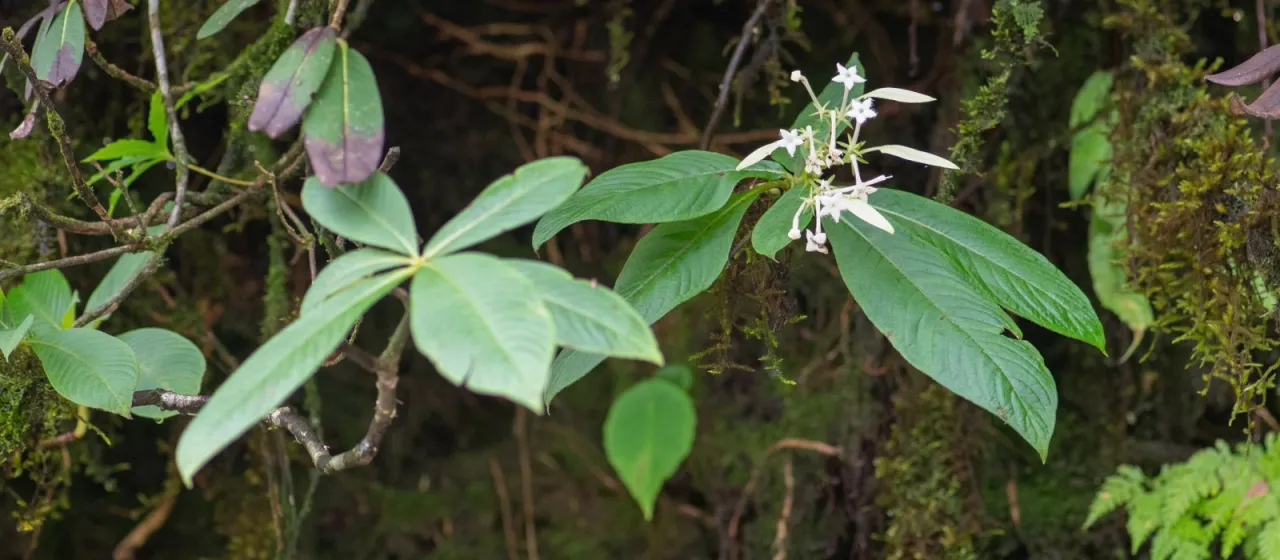
Description
Neohymenopogon parasiticus is a botanical species belonging to the Rubiaceae family. Despite the specific epithet "parasiticus," the plant is an epiphyte, not a true parasite. It relies on host trees for physical support, positioning itself within the forest canopy to maximize exposure to diffuse light and airborne moisture, which are critical for its survival in its native ecosystem.
The native range of this species is centered in the humid mountainous forests of the Himalayas, including regions of Nepal, India, and parts of Southeast Asia. It thrives in high-altitude environments where persistent fog and elevated humidity levels provide the necessary hydration, as the plant lacks a traditional root connection to the forest floor soil.
Botanically, it is characterized by opposite leaves and distinctive leafy bracts that accompany the inflorescences. These bracts serve a vital role in attracting specialized pollinators in the dense understory. The fruit is typically a small, dry capsule containing seeds adapted for wind dispersal, which is a common evolutionary strategy among epiphytic plants in montane regions.
From an agrotechnical perspective, Neohymenopogon parasiticus is not classified as a standard agricultural crop. Its maintenance in botanical gardens or specialized collections requires rigorous climate control. Success in cultivation depends on mimicking the plant's natural canopy environment, specifically focusing on temperature stability, constant humidity, and avoiding stagnant water around the root zone, which is highly prone to fungal decay.
The economic utility of the species remains primarily within the scope of botanical research and ornamental horticulture for rare plant enthusiasts. The main challenges for growers include its intolerance to drought and poor air circulation. Common health issues often involve root rot caused by overwatering, while typical pests include spider mites and mealybugs, which tend to proliferate in the confined, humid conditions required for the plant's growth.