
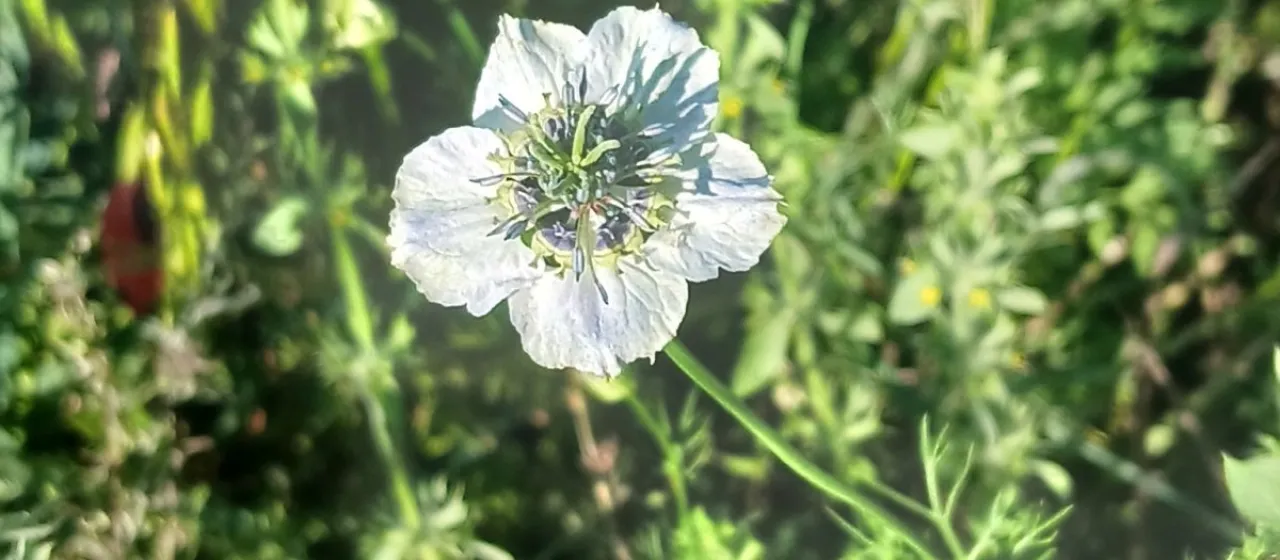
Description
Field fennel-flower (Nigella arvensis) is an annual herbaceous plant belonging to the Ranunculaceae family. While often viewed as a field weed in conventional agriculture, it is increasingly recognized for its potential as a specialized crop due to the presence of valuable essential oils in its seeds, which are utilized in both the culinary and pharmacological industries.
The plant originates from the Mediterranean region but has expanded its range across Europe, Western Asia, and Northern Africa. It has successfully adapted to various habitats, thriving in sunny, open areas, fallow fields, and roadsides, which highlights its strong resilience and ability to establish itself in diverse environmental conditions.
Botanically, this species is characterized by its branched, erect stems reaching heights of up to 40 centimeters. The leaves are finely dissected, and the flowers, which lack true petals, possess showy, petal-like sepals that provide a distinct appearance. The fruit is a multi-follicle containing numerous small, triangular black seeds that constitute the primary harvestable product.
Cultivation requirements focus on providing ample sunlight and well-drained, calcareous soils. Field fennel-flower is notably drought-tolerant but suffers significantly in waterlogged conditions; therefore, fields with heavy, poorly drained clay soils are unsuitable. Sowing should be carried out in early spring when the soil has sufficiently warmed to support germination.
In economic terms, the primary focus is on seed production for medicinal extracts and spices. Beyond its direct agricultural value, the plant acts as a beneficial honey crop, supporting local pollinator populations such as bees. This dual functionality makes it a sustainable choice for diversifying crop rotations and enhancing farm biodiversity.
- Sunlight requirement: Full sun.
- Soil preference: Well-drained, light, lime-rich soil.
- Propagation: By seeds.
- Climate adaptability: Prefers temperate to warm climates.