Norfolk Island hibiscus
Lagunaria patersonia (Andrews) G. Don
Description
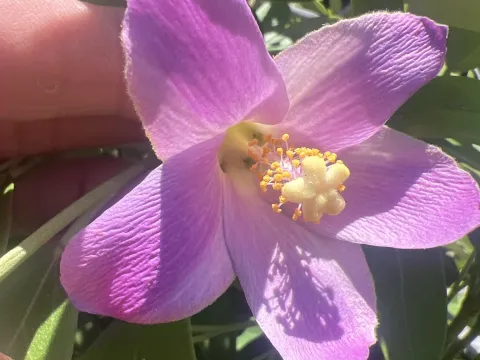
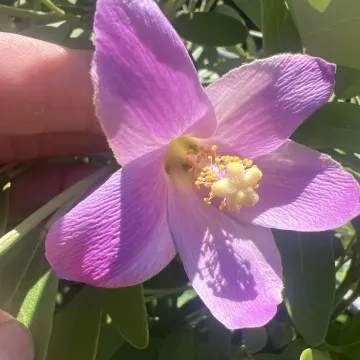
The Norfolk Island hibiscus (Lagunaria patersonia) is a striking evergreen tree belonging to the Malvaceae family. It is widely recognized for its beautiful bell-shaped pink flowers and is often used as an ornamental species in warm-climate landscapes.
Native to Norfolk Island, Lord Howe Island, and coastal Queensland, Australia, this tree thrives in maritime environments. It has been introduced as an ornamental landscape plant in various parts of the world, including California and the Mediterranean basin.
Botanically, the tree typically reaches a height of 10 to 15 meters and features ovate, greyish-green leaves. The most notable characteristic is the fruit, which is a dry capsule containing seeds covered in fine, irritating hairs, necessitating caution during handling and pruning.
For optimal growth, the Norfolk Island hibiscus requires well-drained, sandy to loamy soils and full sun exposure. It is highly valued for its drought tolerance and its exceptional ability to withstand salt-laden winds, making it an excellent candidate for coastal plantings.
While primarily cultivated for its aesthetic appeal, it serves practical purposes as a windbreak or a screen in large gardens and parks. It is susceptible to minor pest issues like aphids or scale insects, though these are generally manageable through standard horticultural practices.
- Family: Malvaceae
- Native Range: Norfolk Island, Australia
- Climate Preference: Mediterranean/Subtropical
- Key Trait: Salt-spray tolerance
- Handling Caution: Irritant hairs on seeds
Photo gallery