
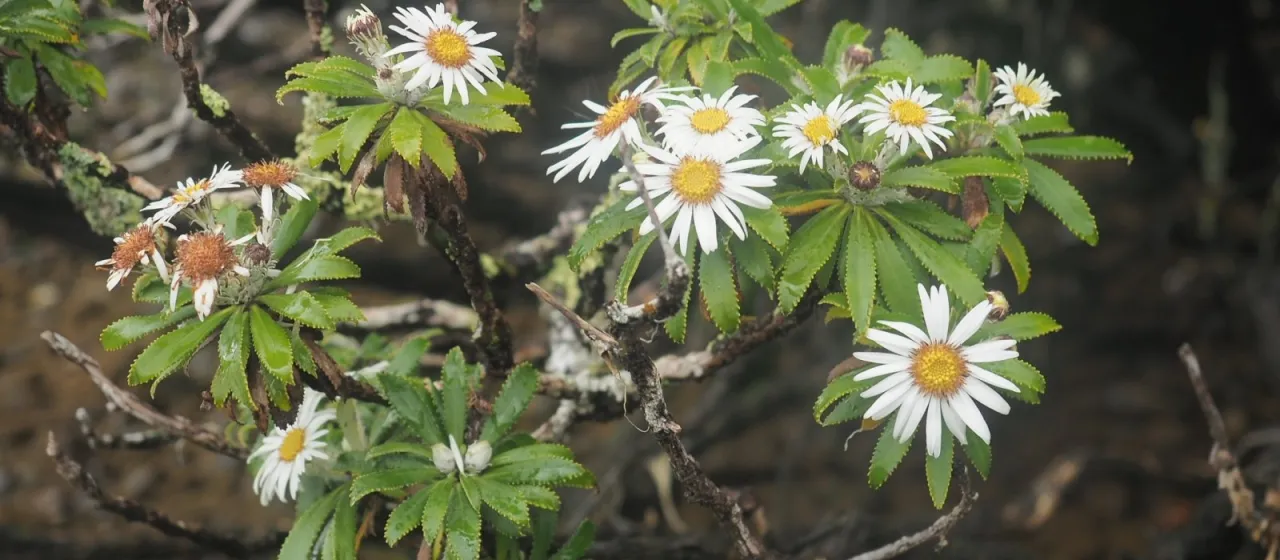
Description
Olearia oporina is an evergreen shrub belonging to the Asteraceae family. Known for its robust nature, it is a significant plant in horticultural circles, particularly valued for its resilience in challenging coastal environments where many other species struggle to establish.
The plant is native to New Zealand, primarily found in the southern coastal regions. It has evolved to thrive in environments exposed to strong winds and saline air. Because of this geographic origin, it is most successfully cultivated in mild, temperate climates that avoid severe freezing temperatures throughout the year.
Botanically, it is defined by its thick, leathery leaves which possess a distinctive white tomentose (hairy) covering on the underside, serving as a protective mechanism. The shrub produces small, daisy-like flower heads that create a delicate contrast against the deep green foliage. It is a slow-growing perennial that can develop into a dense, attractive bush over time.
Successful cultivation requires well-drained, nutrient-rich soil with a neutral to slightly acidic pH. The plant performs best in full sun but tolerates partial shade. Irrigation should be balanced; while the shrub is relatively drought-tolerant once established, it requires consistent moisture during its initial growth stages to ensure a strong root system.
Regarding pests and diseases, the shrub is generally resistant, but may be susceptible to aphids or powdery mildew if airflow is poor or humidity is excessively high. Maintaining proper spacing and regular pruning helps mitigate these risks. It is primarily used in landscaping for hedging, windbreaks, and decorative coastal plantings, providing both structural beauty and ecological stability.