
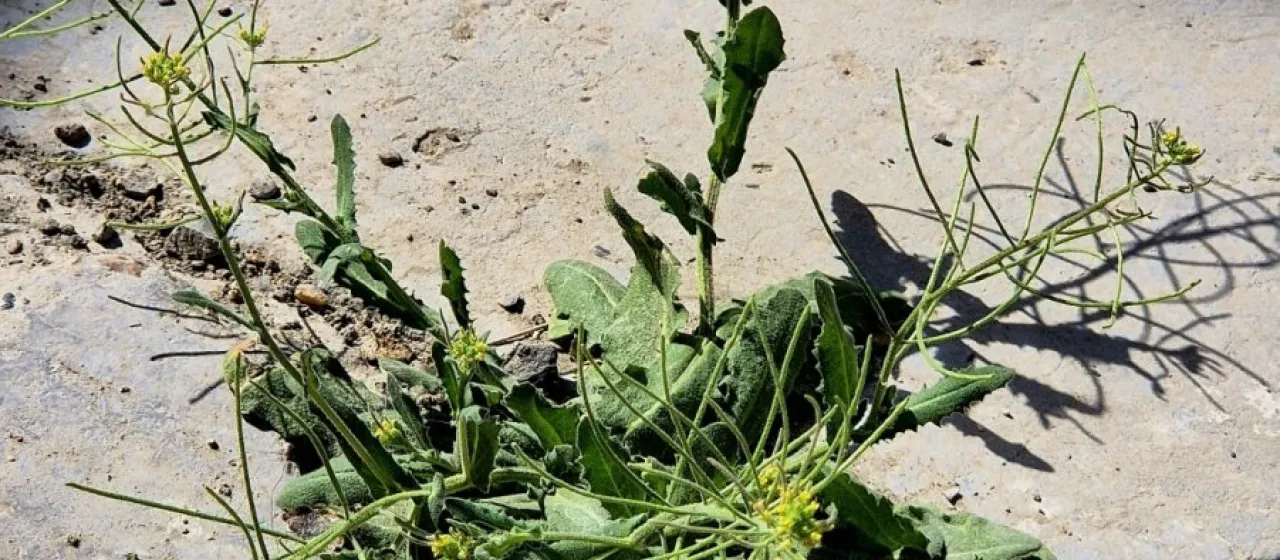
Description
Olimarabidopsis pumila is an annual herbaceous plant belonging to the Brassicaceae family. In agronomy, it is primarily categorized as an invasive weed within agricultural landscapes. Despite its classification as a pest plant, it serves as a valuable subject for botanical research due to its evolutionary proximity to the model organism Arabidopsis thaliana.
The plant originates from the temperate zones of Eurasia, with a distribution range extending from Southeast Europe through the Caucasus to Central Asia. It thrives in open, arid environments, frequently inhabiting steppes, rocky slopes, and fallow fields where it adapts efficiently to limited water availability and nutrient-poor soils.
Botanically, Olimarabidopsis pumila is characterized by its small stature, typically reaching 5–20 cm in height. It features a basal leaf rosette and pubescent stems. The flowers are small, white, and arranged in racemes, typical of the mustard family. Its reproductive cycle is rapid, allowing the plant to set seeds early in the season.
Regarding cultivation requirements, the plant prefers well-drained soils and high sun exposure. It is highly resistant to drought, which makes it a persistent weed in regions with low precipitation. Standard agronomic control methods involve mechanical soil cultivation, such as harrowing and plowing, to eliminate the plant before it reaches the seed-dispersal stage.
The economic impact of this species is mainly associated with crop competition. As a member of the Brassicaceae, it can host several pests, including the crucifer flea beetle, and various fungal diseases that may impact related agricultural crops. Proper field sanitation and crop rotation are essential practices to mitigate the presence of this weed.