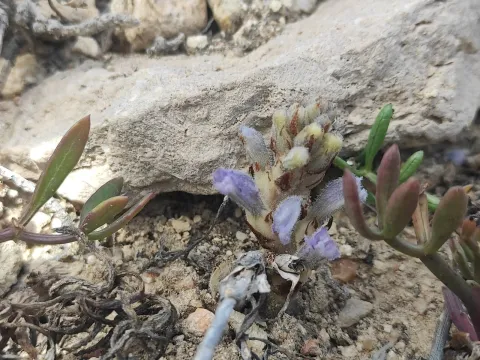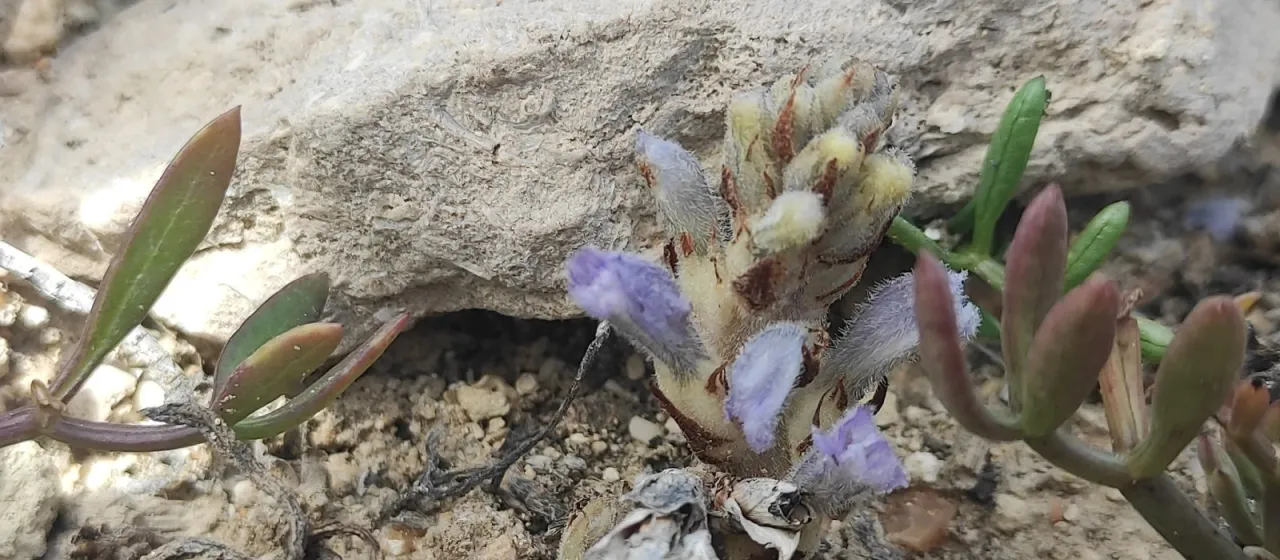
Description
Camphorosma broomrape (Orobanche camphorosmae) is an obligate parasitic herbaceous plant belonging to the Orobanchaceae family. As a holoparasite, it lacks chlorophyll and possesses no photosynthetic capabilities. Its survival depends entirely on the absorption of water and nutrients from the root systems of specific host plants, primarily those within the Camphorosma genus, through specialized structures known as haustoria.
The native range of this species encompasses arid and semi-arid regions throughout Eurasia. It is well-adapted to habitats characterized by saline soils and low moisture availability. Unlike crops, which require nutrient-rich soil and specific management, this plant thrives in ecological niches where the host plant is present, often in harsh environments where other plant life struggles to survive.
Botanically, the plant remains mostly subterranean, except for the flowering stems that appear during the reproductive stage. These stems are typically covered with scale-like leaves and topped with spikes of small flowers. The reproductive efficiency is extremely high, as a single plant produces thousands of minute, dust-like seeds that can persist in the soil seed bank for many years, awaiting chemical signals from a host root to germinate.
Regarding its requirements, the plant does not require cultivation as it is a parasite rather than an agricultural crop. Its development is dictated by the chemical triggers released by the host roots and the environmental conditions that favor host growth. Agronomical interventions focus on monitoring areas where it may negatively impact native or wild vegetation, as it serves no role in conventional farming.
From a хозяйственное usage perspective, Orobanche camphorosmae has no economic or agricultural value. It is strictly a biological parasite. While it has few specialized pests, it can be affected by various pathogenic fungi that attack the inflorescences. Management of this species is usually limited to ecological observation and ensuring it does not spread into sensitive areas where host populations might be threatened.
Photo gallery