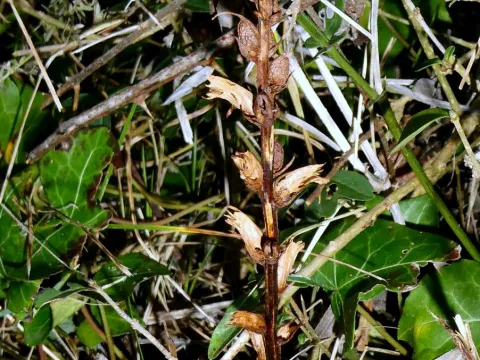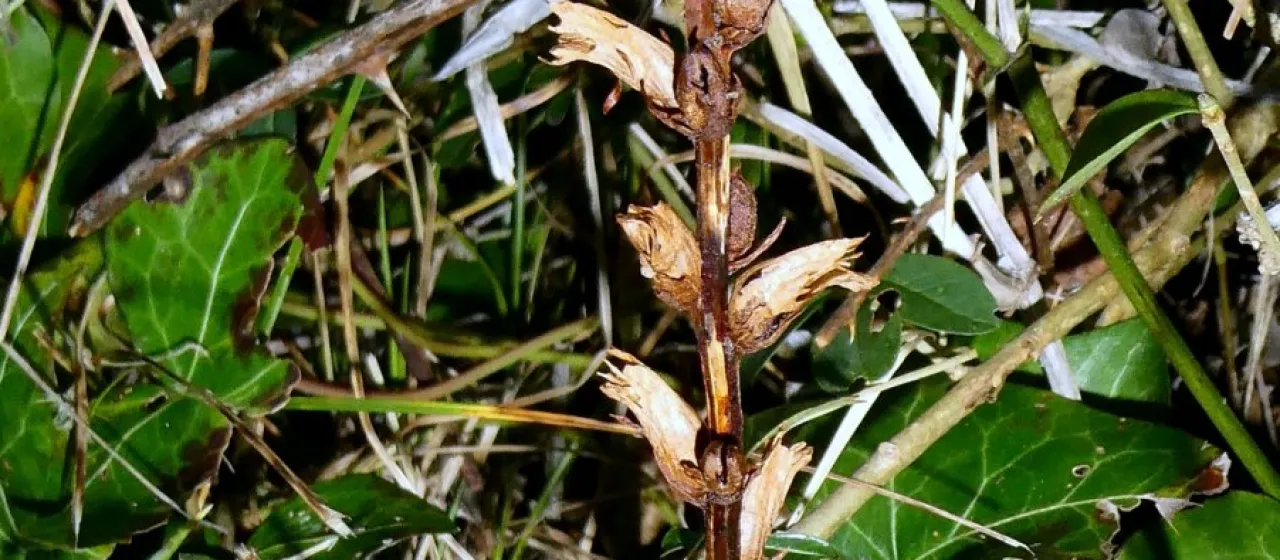
Description
Ivy broomrape (Orobanche hederae) is a perennial, holoparasitic plant belonging to the family Orobanchaceae. Lacking chlorophyll, this plant is completely dependent on its host, primarily the genus Hedera, for water and essential nutrients, which it extracts via specialized root structures known as haustoria.
The origin of Ivy broomrape is Mediterranean, though it has successfully expanded its range across Western and Central Europe and into parts of Asia. Its distribution is strictly tied to the geographic presence of ivy, as it cannot survive or reproduce without the chemical signals provided by the host plant's root exudates to trigger germination.
Botanically, it appears as an unbranched, succulent stem ranging from 10 to 50 cm in height. The foliage is reduced to small, brown scales. The plant produces a dense inflorescence of tubular, two-lipped flowers that vary in color from pale cream to reddish-purple. Its survival strategy relies on the production of thousands of tiny, wind-dispersed seeds that remain dormant in the soil for extended periods.
Environmentally, the plant favors shady, moist habitats such as woodland floors, hedgerows, and neglected garden areas where ivy thrives. It has no agricultural utility and is classified as a troublesome weed in ornamental horticulture. Proper management involves the manual removal of stems before they reach the seeding stage to prevent further infestation in the garden.
While not a typical agricultural crop, it is a significant factor in ornamental plant pathology. The primary negative impacts include the stunting of ivy growth, loss of foliage vigor, and the potential for long-term population buildup in infected areas. Monitoring and early intervention remain the only effective ways to mitigate the damage caused by this parasite to landscape plantings.
Photo gallery