Description
Yellow broomrape (Orobanche lutea) is a root parasitic plant belonging to the Orobanchaceae family. As an obligate parasite, it lacks chlorophyll and relies entirely on a host plant for nutrients and water. It specifically targets the root systems of various leguminous plants, predominantly alfalfa and clover, causing significant physiological stress to the host.
The native range of this species encompasses Europe and parts of Western Asia. It typically thrives in regions with warm, temperate climates and is often associated with limestone or chalky soil types. Its distribution is closely linked to the cultivation patterns of forage legumes, as the parasite spreads its microscopic seeds across agricultural landscapes where these hosts are frequently grown.
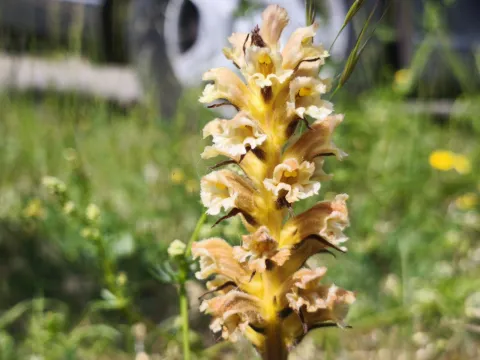
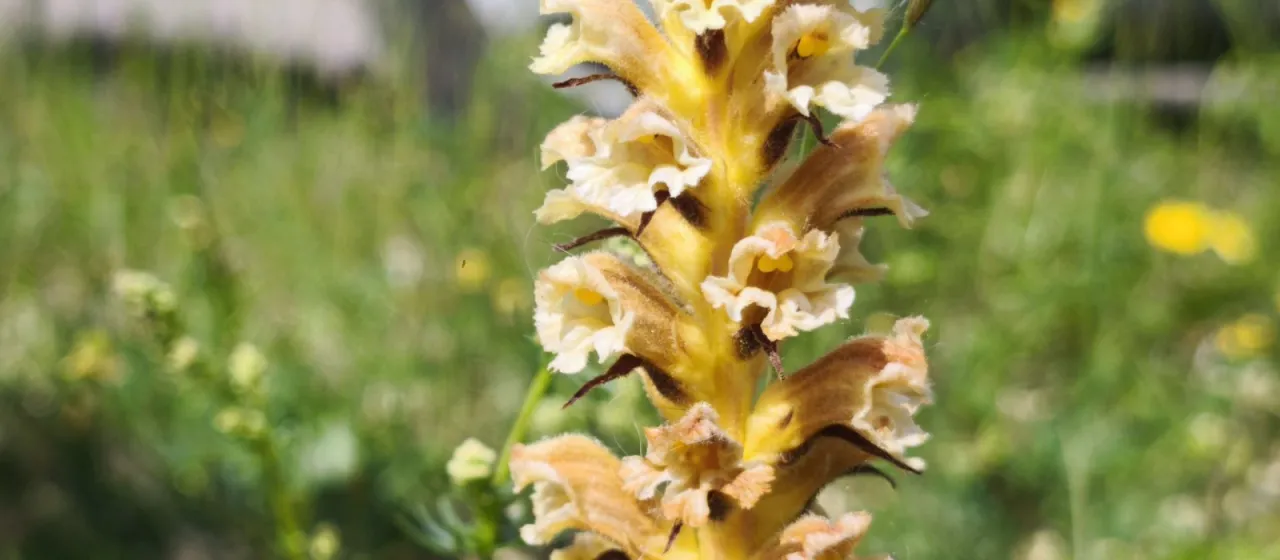
Botanically, the plant consists of a fleshy, unbranched stem that can reach heights of 15 to 40 centimeters. The leaves are reduced to small, scale-like structures along the stem. The inflorescence is a dense, spike-like cluster of yellow-red flowers. A single plant is capable of producing thousands of tiny, dust-like seeds that remain viable in the soil for extended periods, waiting for the chemical cues of a suitable host root to germinate.
Management of yellow broomrape is challenging due to its biological nature. Agronomic practices focus on long-term crop rotation, avoiding susceptible host crops for intervals of up to eight years to starve the parasite seed bank in the soil. Deep plowing and the use of trap crops can also assist in reducing infestation levels. Chemical control remains limited and is mostly restricted to targeted applications in high-value forage fields.
From an agricultural perspective, Orobanche lutea has no economic value and is considered a severe pest in fodder crop production. Its impact is characterized by reduced biomass, poor regrowth, and, in heavy infestations, complete crop failure. As there are few natural pests that control its population, farm hygiene—such as cleaning machinery and using certified, parasite-free seeds—is essential to prevent its introduction into new fields.
Photo gallery