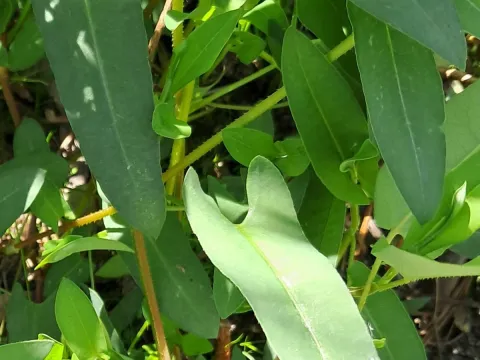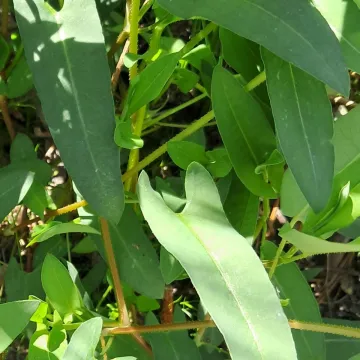
Arrow-leaved tearthumb
Persicaria sagittata
Description
Arrow-leaved tearthumb, botanically identified as Persicaria sagittata, is an annual herbaceous plant belonging to the Polygonaceae family. It is distinctively characterized by its sagittate leaves and four-angled stems armed with sharp, downward-curving prickles, which provide the plant with climbing support. This species is highly specialized for moist and wetland environments.
The plant originates from East Asia and has naturalized across vast regions of North America. It typically thrives in marshes, floodplains, and damp ditches where water is abundant. In agricultural settings, it is valued for its ability to stabilize soil in riparian zones and its high tolerance for saturated substrates that are unsuitable for standard field crops.
Botanically, Persicaria sagittata features a sprawling growth habit, often reaching lengths of over one meter. Its inflorescences consist of small, clustered flowers ranging from white to pinkish, blooming from late summer until the first frost. The plant possesses a shallow root system, facilitating quick nutrient uptake in hydric soils and rapid biomass accumulation during the warm season.
Regarding cultivation requirements, the plant demands consistent soil moisture to prevent dehydration. It flourishes in full sun or partial shade, provided the nutrient level is sufficient. For commercial propagation, direct seeding in spring is the standard procedure. Because of its prickly nature and aggressive growth, farmers must manage the density of the planting to ensure ease of harvesting or access.
Agricultural and economic utilization includes phytoremediation projects and its potential as a component in specialty forage blends, though processing is required to handle the prickly stems. While generally resilient, the plant can be susceptible to fungal diseases like rust and powdery mildew under poor air circulation conditions. Common pests include aphids and various beetles, which are typically managed through integrated pest control methods.
Photo gallery