Petrosavia sakuraii
Petrosavia sakuraii
Description
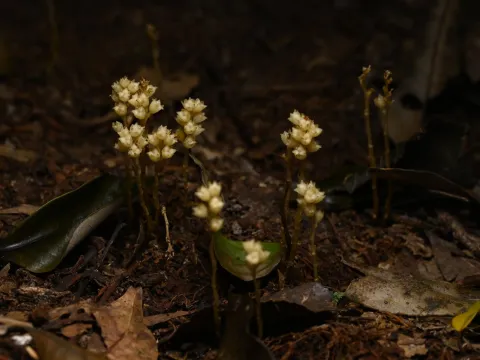
Petrosavia sakuraii is a rare herbaceous plant species belonging to the family Petrosaviaceae. It is not classified as a commercial agricultural crop, as it is a specialized mycoheterotroph that derives its nutrition through a complex symbiotic relationship with underground fungi rather than through photosynthesis.
The plant is native to parts of East Asia, including Japan, where it inhabits humid forest floors. Its distribution is highly localized, restricted by the specific presence of the fungal partners required for its survival. Because of this specialized ecological niche, it does not exist in any agricultural system or traditional cultivation, and it lacks standard agronomic potential.
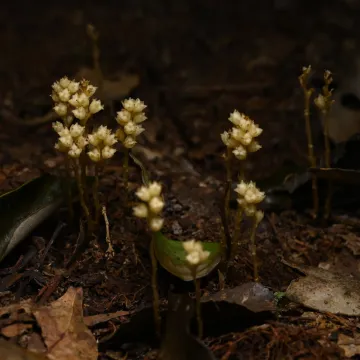
Botanically, the plant is characterized by its reduced structure. It lacks functional leaves for photosynthesis, displaying only scale-like leaves along a slender stem. The flowers are small and structurally simple. The root system is vestigial, as the plant relies almost entirely on the mycorrhizal fungi to extract nutrients from the soil organic matter.
There are no agricultural techniques associated with this plant. It is impossible to manage in a farm environment, as it cannot compete with crop species and requires highly specific, stable environmental conditions. It holds no value for food, fodder, or industry, and its conservation is primarily an academic and environmental concern rather than an agricultural one.
Key factors influencing the population status include:
- Preservation of native forest ecosystems.
- Maintenance of precise soil moisture levels.
- Availability of compatible fungal symbionts.
- Protection against environmental degradation.
Scientific interest in Petrosavia sakuraii remains focused on evolutionary botany. By studying its unique metabolic pathways, scientists aim to better understand the evolutionary history of basal monocots and the mechanisms by which certain plants adapt to a parasitic-like existence with fungal partners.
Photo gallery