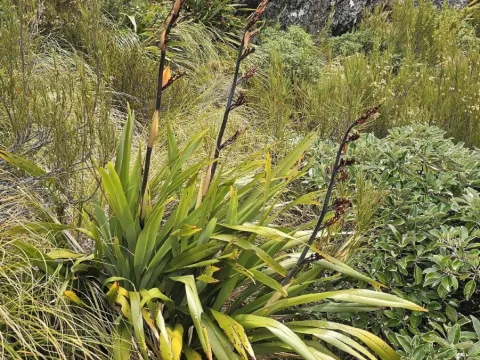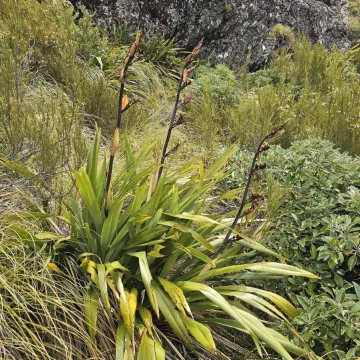
Mountain flax
Phormium colensoi
Description
Mountain flax (lat. Phormium colensoi) is a perennial herbaceous plant belonging to the Asphodelaceae family. It is a smaller, more graceful relative of the common New Zealand flax, characterized by its drooping leaves and softer texture, which makes it highly valued both in ornamental horticulture and specialized fiber production.
Native to New Zealand, this plant is naturally found in mountain and subalpine regions, thriving on rocky slopes and in open, well-drained soils. Its evolutionary adaptation to cooler, rugged environments makes it a hardy species capable of withstanding significant climatic fluctuations compared to more tropical or lowland relatives.
Botanically, the plant forms dense clumps of sword-shaped leaves arising from a tough, fibrous rhizome. Unlike other species, the leaves of Phormium colensoi are often more flexible and less prone to splitting along the margins. The flowering stalks can rise well above the foliage, producing nectar-rich flowers that play a key role in the local ecosystem by supporting pollinator populations.
Cultivation requires well-drained, fertile soil that mimics its natural habitat conditions. While it is relatively low-maintenance, success in agricultural settings depends on preventing waterlogging, as the rhizomes are susceptible to fungal rot in anaerobic conditions. It performs best in full sun but can tolerate partial shade, provided it has enough light to maintain leaf vigor.
The economic value of this crop is primarily linked to its strong leaf fibers, which are traditionally used for weaving mats, ropes, and traditional handicrafts. Additionally, it has become a staple in sustainable landscaping due to its structural aesthetic and ability to prevent soil erosion on slopes. Disease management involves monitoring for common pests like scale insects and ensuring adequate spacing to prevent moisture-related foliage diseases.
Photo gallery