Syrian thistle
Picnomon acarna (L.) Cass.
Description
Syrian thistle (Picnomon acarna) is a herbaceous perennial belonging to the Asteraceae family. Often categorized in agricultural science as a resilient weed, this species possesses unique biological traits that allow it to thrive in harsh environments where more sensitive agricultural crops might struggle to survive.
Originating from the Mediterranean region and parts of Western Asia, this plant has adapted to diverse soil conditions, ranging from dry, rocky terrain to clay-heavy agricultural fields. Its ability to colonize fallow lands, pastures, and roadsides makes it a common sight in southern climates, where it can quickly establish dense populations if left unmanaged.
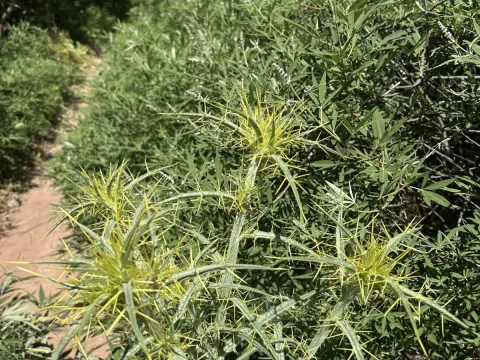
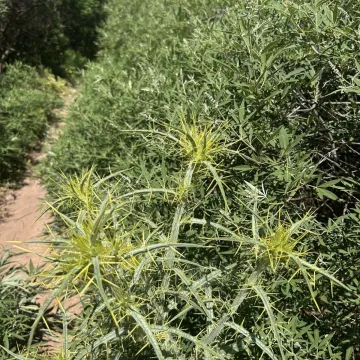
Botanically, Picnomon acarna is recognized by its dense, spine-covered foliage and stiff stems that can grow up to half a meter in height. The inflorescences are characterized by spiny involucres surrounding yellowish to purple florets. The plant produces achenes equipped with pappus, which facilitate effective wind dispersal, ensuring the survival of the population across varied landscapes.
Management of this species in an agricultural context requires a strategic approach. Due to its deep taproot and drought tolerance, simple surface cultivation is often insufficient. Effective control methods include early-season tillage before flowering and the targeted application of herbicides during the rosette stage to minimize the soil seed bank and prevent further proliferation into cultivated areas.
While often viewed as a nuisance, the Syrian thistle holds some ecological value as a late-season nectar source for pollinators in arid regions. Despite its spiny nature, which limits its palatability to livestock, research into its chemical composition continues to investigate potential pharmacological properties. For the modern agronomist, understanding the life cycle of Picnomon acarna is key to maintaining high field yields.
- High drought tolerance.
- Wind-dispersed seeds.
- Strong taproot system.
- Protection against herbivores.
- Preference for sunny habitats.
Photo gallery