Seashore plantain
Plantago decipiens
Description
Seashore plantain (Plantago decipiens) is a perennial herbaceous plant belonging to the Plantaginaceae family. As a specialized halophyte, it has evolved to thrive in environments with high salinity levels where most conventional agricultural crops would fail. This species serves as a valuable model organism for researchers studying plant adaptation to saline soils.
The native range of Plantago decipiens is primarily situated along the coastal regions of North America, where it occupies tidal marshes and saline meadows. These environments are characterized by frequent inundation and high levels of sodium chloride in the soil. Its distribution is strictly limited to these coastal zones due to its physiological dependence on high salt concentrations.
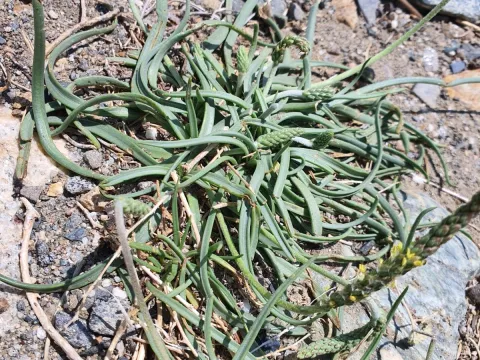
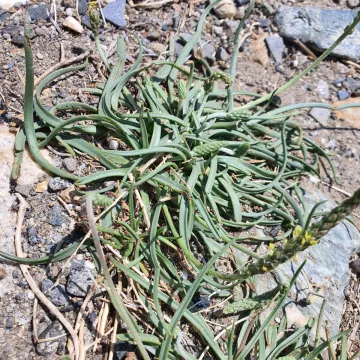
Botanically, the plant is distinguished by its fleshy, narrow leaves arranged in a basal rosette, providing an efficient mechanism for moisture retention. The root system is robust and fibrous, optimized for anchorage in loose, saline, and waterlogged substrates. The inflorescences are dense, slender spikes that emerge on long stalks, producing numerous seeds dispersed mainly by tidal waters.
Regarding cultivation and agrotechnics, Plantago decipiens requires specific saline conditions and consistent soil moisture. In a controlled or agricultural setting, successful establishment depends on replicating the natural salt gradient of its native habitat. Standard fertilizers are often ineffective or even detrimental, as the plant is adapted to nutrient-poor, saline environments rather than nutrient-rich agricultural soils.
The хозяйственное utilization (economic use) of this species is largely ecological:
- Coastal erosion control and soil stabilization.
- Phytoremediation of salt-affected lands.
- Genetic resource for breeding salt-tolerant crop varieties.
Common diseases of this species include root rots and fungal infections, typically triggered by poor drainage or stagnant water conditions. Pests are usually limited to specialized coastal insects, though the plant's natural chemical defenses provide significant resistance. Careful management of water flow and soil aeration remains the primary strategy for maintaining healthy stands of this species.
Photo gallery