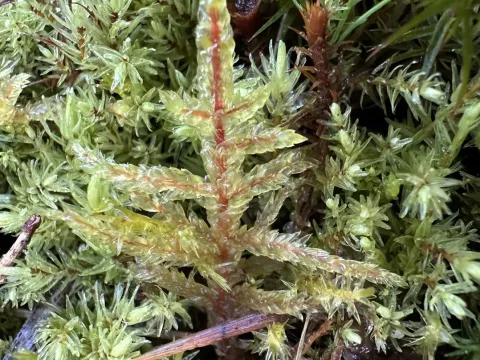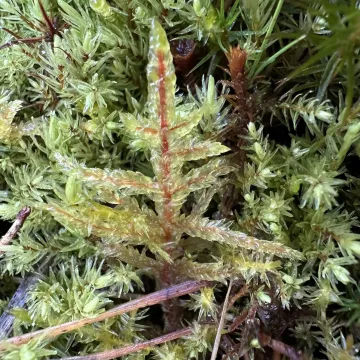
Schreber's big red stem moss
Pleurozium schreberi
Description
Pleurozium schreberi, commonly known as Schreber's big red stem moss, is a significant member of the Hylocomiaceae family. While not an agricultural crop in the conventional sense, it is an essential component of forest floor ecosystems, particularly in boreal regions. It forms dense, carpet-like mats that significantly influence the microclimate, nutrient cycling, and water retention capacity of forest soils.
The species has a vast natural distribution, primarily found in the Northern Hemisphere across Europe, Asia, and North America. It is typically associated with coniferous forests, where it thrives in moist, acidic environments. Its prevalence in these ecosystems is due to its ability to colonize and spread efficiently across the forest floor, competing successfully with other vegetation under low-light conditions.
Botanically, the plant is recognized by its distinct red-tinted stems and pinnate branching pattern. This structure gives it a robust, feather-like appearance. The species is highly adapted to nutrient-poor soils, relying partly on the deposition of nutrients from the atmosphere. It reproduces primarily through vegetative growth, forming large, interconnected mats that can persist for many years.
Regarding its ecological requirements, the moss prefers high humidity and moderate temperatures. It does not require specific agricultural cultivation; rather, its management is centered on silvicultural practices. In forest management, the density of this moss is often monitored, as it can occasionally hinder the natural regeneration of trees by creating a thick, insulating layer that traps moisture and keeps the soil surface cool.
The practical applications for this species include:
- Landscape design and restoration of natural forest floor habitats.
- Use in horticultural applications as a natural mulch or soil moisture retainer.
- Bioindication and air quality monitoring, as the moss accumulates heavy metals from the air.
- Crafting and decorative purposes due to its vibrant green color and persistent texture.
Pathogens and pests for this moss are primarily fungi that thrive in waterlogged conditions or during periods of excessive humidity. Environmental stressors such as drought, extreme pollution, and excessive trampling can also degrade its health. Despite these threats, Pleurozium schreberi remains a resilient and dominant species within its natural range, demonstrating high adaptability to cold climates and shaded forest environments.
Photo gallery