Silky sweet pea bush
Podalyria sericea
Description
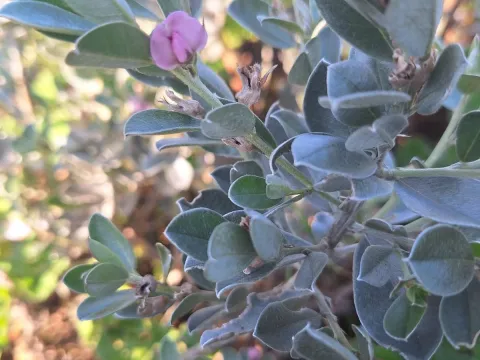
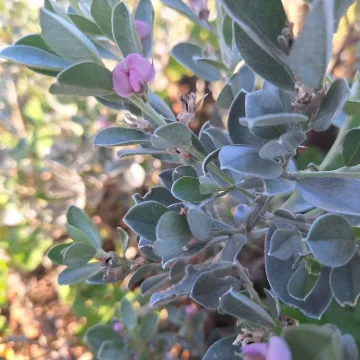
Podalyria sericea, commonly known as the silky sweet pea bush, is an evergreen shrub belonging to the Fabaceae family. This plant is widely recognized for its beautiful silvery foliage, which features a dense covering of fine, silky hairs that shimmer under sunlight, making it a highly prized specimen for ornamental horticulture.
Native to the Western Cape province of South Africa, this species is well-adapted to Mediterranean-type climates. In its natural habitat, it thrives in rocky, well-drained soils on mountain slopes. This evolutionary background explains the plant's tolerance for poor, sandy soils and its need for a balance between winter rainfall and dry, sunny summer conditions.
Botanically, the plant forms a rounded shrub that typically reaches heights of 1 to 1.5 meters. The leaves are simple and lanceolate, with a distinctive velvet-like texture due to the pubescence. During the spring, the bush produces pea-like flowers in shades of pink or mauve, which emit a sweet, honey-like fragrance, attracting bees and other essential pollinators to the garden.
Successful cultivation requires specific environmental conditions. It demands full sun exposure and excellent soil drainage; waterlogged soil is the primary cause of failure, often leading to root rot. While it is somewhat drought-tolerant once established, young plants require consistent, light watering. It is not frost-tolerant and should be sheltered in regions with freezing temperatures.
In terms of хозяйственного (utilitarian) use, it is strictly an ornamental plant used for landscaping, rock gardens, and xeriscaping. It serves as an excellent structural plant for border gardens. Maintenance involves light pruning after flowering to encourage dense growth. Common pests include aphids and mites, which are generally managed through good air circulation and, if necessary, targeted horticultural soaps.
Photo gallery