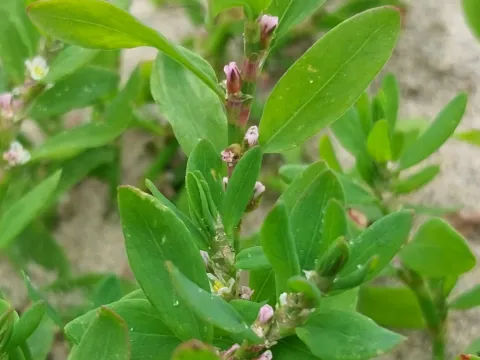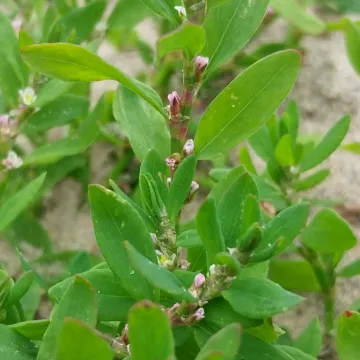
Prostrate knotweed
Polygonum aviculare L.
Description
Prostrate knotweed (lat. Polygonum aviculare L.) is an annual herbaceous plant belonging to the buckwheat family (Polygonaceae). While frequently identified as a persistent weed in agricultural fields, this species possesses significant nutritional and medicinal value, characterizing it as a versatile botanical entity.
The origin of this plant is broadly Eurasian, though it has become a cosmopolitan species distributed across almost every temperate region globally. Its high adaptability allows it to colonize diverse environments, including cultivated fields, degraded pastures, and urban landscapes where soil compaction is prevalent.
Botanically, the plant is recognized by its prostrate, wiry, branched stems that create a dense mat along the ground. The leaves are small, alternate, and often bluish-green in color. The flowers are inconspicuous, clustered in the leaf axils, and capable of self-pollination, which ensures consistent seed production throughout the growing season.
Regarding cultivation requirements, the plant thrives in full sun and can tolerate a wide variety of soil types, ranging from sandy to heavy clay. It is remarkably resilient to drought and mechanical stress. In an agricultural context, management requires early intervention, as the plant's rapid growth and prolific seed dispersal can quickly outcompete less vigorous crops.
The economic utility of the plant is diverse, serving as a forage source for poultry and livestock, particularly in pastoral systems. In pharmaceutical applications, it is valued for its tannins, flavonoids, and vitamin content, utilized in traditional medicine for its diuretic and anti-inflammatory properties. Typical pests include aphids and specific coleopterans, while fungal infections like powdery mildew may occur under high humidity conditions.
Photo gallery