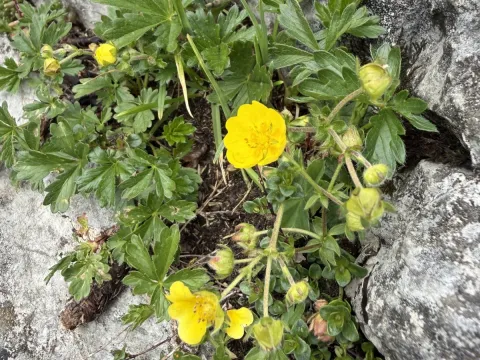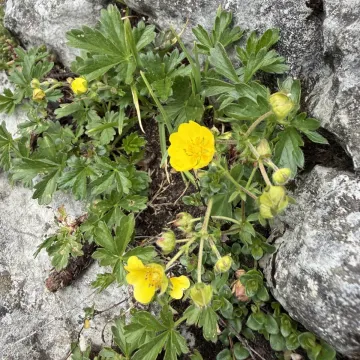
Golden cinquefoil
Potentilla aurea
Description
Golden cinquefoil (Potentilla aurea) is a perennial herbaceous plant belonging to the Rosaceae family. In agricultural and horticultural contexts, it is highly valued for its ground-covering capabilities, cold hardiness, and its ability to thrive in poor, rocky soils where other species might struggle.
The plant is native to the mountainous regions of Central and Southern Europe, flourishing in subalpine and alpine meadows. Its distribution as a cultivated species has expanded to various temperate regions worldwide, where it is utilized for rock gardening and erosion control on slopes, favored by its natural adaptation to cooler climates.
Botanically, it forms low-growing mats, typically reaching a height of 10–20 cm. Its leaves are palmately divided, and the plant produces a dense display of bright golden-yellow flowers during late spring and early summer. The root system is sturdy and fibrous, enabling it to penetrate rocky crevices and stabilize the surrounding soil effectively.
The cultivation requirements focus on well-draining soil and a sunny location. It is essential to avoid sites where water accumulates, as the roots are susceptible to rot in boggy conditions. The plant performs best in slightly acidic to neutral soils and requires minimal intervention once established, though occasional weeding is necessary to prevent competition from more aggressive weeds.
Economically, the species is primarily used in landscaping for decorative purposes, especially in alpine-style gardens. It is also recognized for its medicinal potential in traditional practices, where its aerial parts are harvested for secondary metabolites. Pests such as aphids or spider mites can occasionally affect the plant, and fungal leaf spot may appear if air circulation is poor or humidity levels remain excessively high.
Photo gallery