Carolina clubmoss
Pseudolycopodiella caroliniana
Description
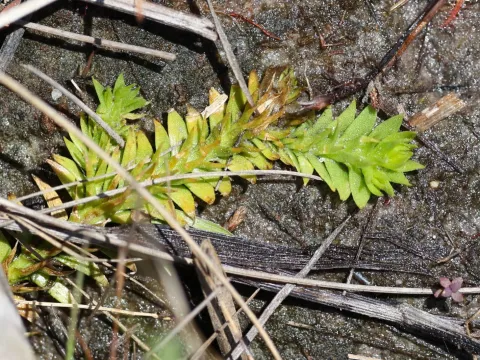
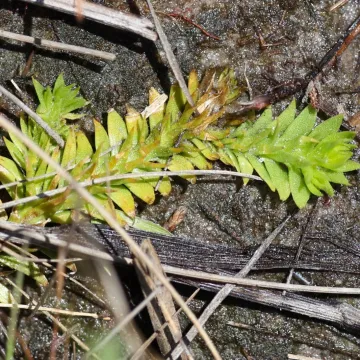
Carolina clubmoss (Pseudolycopodiella caroliniana) is a perennial, spore-bearing vascular plant belonging to the Lycopodiaceae family. It is a specialized species that exhibits a prostrate growth habit, forming low-lying mats on wet, sandy, or peaty soils in its natural environment.
The distribution of this plant is quite broad, stretching across North and South America, as well as parts of Africa and Asia. It is typically found in wetlands, seepage slopes, and acidic bogs, where it relies on high water tables and nutrient-poor substrate to outcompete more aggressive vegetation types.
Botanically, the plant is identified by its creeping stems that produce vertical, terminal strobili—structures responsible for spore production. The leaves are generally small, scale-like, and appressed, reflecting the plant's adaptation to specialized environmental niches where moisture conservation is a primary challenge.
Cultivation requirements for Carolina clubmoss are intensive, necessitating an acidic, peat-based substrate and constant moisture levels. Successful growth depends on the presence of symbiotic mycorrhizal fungi, which assist the plant in nutrient uptake. It is not considered a traditional crop but is valued in specialized horticultural circles for botanical collections.
The economic use is currently limited to ornamental landscape design in specialized moisture-loving gardens or wetland restoration projects. Pests are minimal, though the plant is sensitive to root rot and fungal infections caused by poor drainage or stagnant water in controlled environments.
Photo gallery