Psilostrophe cooperi
Psilostrophe cooperi
Description
Psilostrophe cooperi, commonly known as Cooper's paperflower, is a perennial subshrub belonging to the Asteraceae family. In agricultural science, this species is primarily studied as a toxic range plant that poses significant risks to livestock grazing in the arid regions of the southwestern United States and Mexico.
The plant is native to the desert ecosystems of the Mojave and Sonoran regions. Its habitat is typically restricted to dry, rocky slopes, canyon floors, and sandy plains where moisture availability is extremely low. It thrives in environments where most traditional forage species fail to survive.
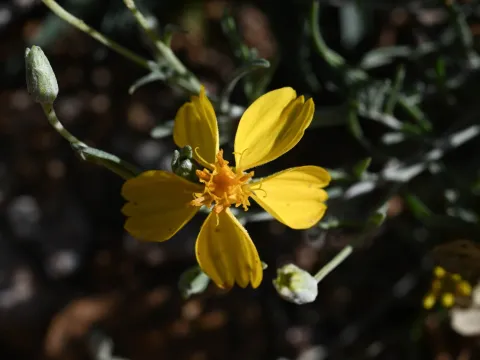
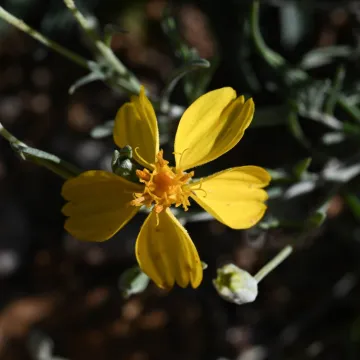
Botanically, it is recognized by its dense, branching structure, typically reaching a height of 40 to 60 centimeters. The foliage is covered with a grayish, felt-like pubescence that minimizes water loss. The plant produces distinct yellow, daisy-like flower heads which, due to their parchment-like texture, persist on the plant even after drying.
Requirements for growth are minimal as the plant is a highly specialized xerophyte. It demands full sun exposure and performs best in well-drained, nutrient-poor, or alkaline soils. Unlike cultivated crops, its agricultural management focuses on suppression rather than growth, as it tends to proliferate in overgrazed or disturbed desert landscapes.
The economic and agricultural impact of Psilostrophe cooperi is strictly negative due to its toxic chemical profile, specifically sesquiterpene lactones. These compounds cause chronic poisoning in sheep and cattle, often referred to as "paperflower poisoning." Symptoms include progressive weakness, weight loss, and digestive distress. Effective management is achieved through targeted herbicide application and pasture rotation to prevent livestock exposure.
Photo gallery