Whisk fern
Psilotum nudum
Description
Whisk fern, botanically known as Psilotum nudum, is an ancient vascular plant belonging to the Psilotaceae family. It is widely considered a living fossil because its morphology has remained largely unchanged for millions of years. This primitive plant lacks true roots and leaves, relying instead on green, dichotomously branching stems for photosynthesis.
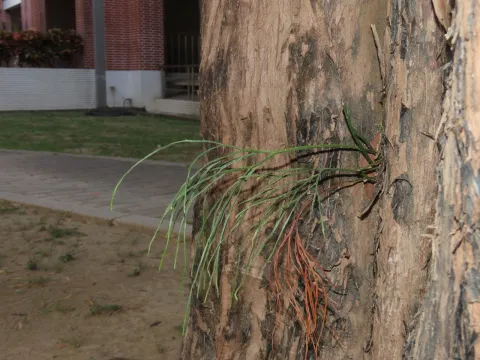
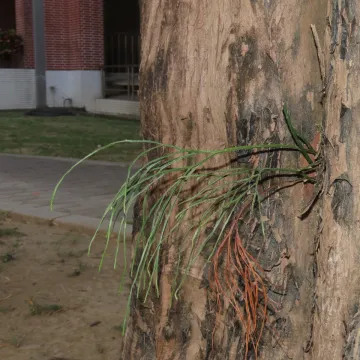
The natural range of Psilotum nudum is extensive, covering tropical and subtropical regions of the world, including parts of North and South America, Asia, and Australia. In its natural habitat, it commonly grows as an epiphyte in tree forks or in rocky crevices where organic debris accumulates. Its evolution is closely linked to its ability to thrive in humid forest environments.
Regarding its botanical features, the whisk fern possesses underground rhizomes that lack root hairs. Instead, it relies on a symbiotic relationship with mycorrhizal fungi to absorb nutrients from the soil. The sporangia, which contain spores for reproduction, appear as small, yellow, three-lobed structures on the side of the green stems, providing a unique aesthetic appearance to the plant.
When cultivating the whisk fern, success depends on mimicking its natural environment. It requires a well-draining, loose, and acidic growing medium, such as a mix of peat, bark, and perlite. The plant thrives in high humidity and temperatures between 20°C and 25°C. It is crucial to maintain consistent moisture without allowing the potting mix to become waterlogged, as the rhizomes are highly susceptible to root rot.
- Provide bright, indirect sunlight.
- Ensure excellent drainage in the container.
- Avoid harsh chemical fertilizers that kill mycorrhizal fungi.
- Maintain high ambient humidity levels.
The whisk fern is primarily used as an ornamental specimen in botanical collections and greenhouses. It is rarely troubled by pests, though mealybugs can occasionally be an issue. Proper care emphasizes the maintenance of the soil ecology, ensuring the health of the fungal symbionts that are vital to the plant's survival and growth.
Photo gallery