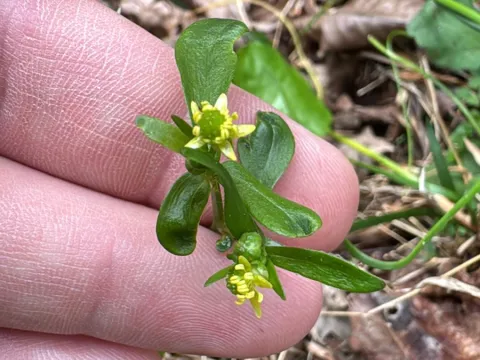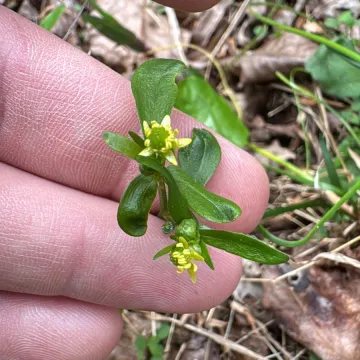
Littleleaf buttercup
Ranunculus abortivus
Description
The littleleaf buttercup (Ranunculus abortivus) is a herbaceous plant belonging to the Ranunculaceae family. Within the agricultural sector, it is predominantly recognized as a weed species that presents challenges in managed ecosystems, requiring integrated pest management strategies to prevent it from outcompeting desirable crops.
Native to North America, the species has successfully naturalized in diverse temperate environments globally. It is commonly found in moist habitats, woodlands, and field edges, often encroaching into cultivated land where it utilizes available soil moisture and nutrients that would otherwise be allocated to staple agricultural crops.
Botanically, Ranunculus abortivus is characterized by its basal leaves, which are typically rounded or cordate, and smaller stem leaves that are often divided. The flowers are small, with yellow petals that are frequently shorter than the sepals, leading to its distinctive appearance. This plant typically follows a biennial or annual growth habit, allowing for rapid seed set and dispersal.
Regarding environmental requirements, the littleleaf buttercup thrives in rich, moist, and well-drained soils. It exhibits significant adaptability to varying light intensities, ranging from partial shade to full sun. Its ability to tolerate different moisture regimes makes it a particularly persistent component of the weed flora in fields with high organic matter content or near riparian zones.
In terms of agricultural significance, the management of this plant is vital to maintain optimal harvest yields. It does not have a commercial application and is generally treated as a management target.
- Competition for water and essential macronutrients.
- Dispersal facilitated by agricultural machinery and soil movement.
- Susceptibility to standard broad-leaf herbicide control.
- Potential risks to livestock health if consumed in large quantities in pasture settings.
Photo gallery