Smallflower buttercup
Ranunculus parviflorus
Description
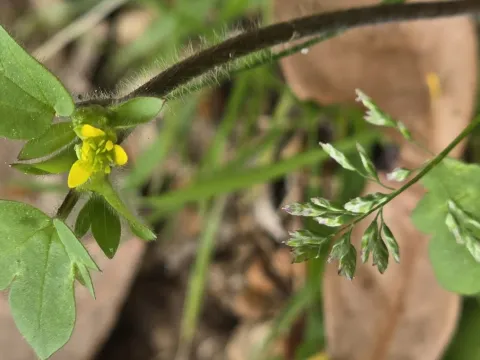
Smallflower buttercup (Latin Ranunculus parviflorus) is an annual herbaceous plant belonging to the Ranunculaceae family. Within an agricultural context, it is recognized as a weed that colonizes disturbed sites and can become problematic in crops, pastures, and orchards where soil moisture remains high throughout the growing season.
Originally native to the Mediterranean region and parts of Europe, the smallflower buttercup has successfully expanded its range globally. It is now widely distributed across North and South America, as well as parts of Australia. Its ability to adapt to diverse environments allows it to thrive in various soil types, particularly in regions that provide sufficient spring rainfall for germination.
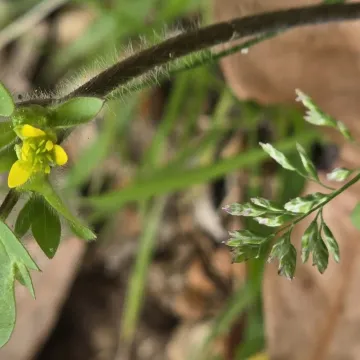
Botanically, the species is defined by its small, yellowish-green flowers, which are often inconspicuous and nestled within the foliage. The plant features palmate-lobed leaves and stems covered in fine, soft hairs. As an annual, it relies entirely on seed production for survival, and the seeds demonstrate a remarkable ability to persist in the seed bank for extended periods, facilitating rapid re-emergence.
The plant thrives in moist, fertile soils, often showing a preference for sites with neutral to slightly acidic pH levels. In terms of agronomy, effective management requires an integrated approach. Because the plant competes for resources and potential space, maintaining a competitive crop canopy and utilizing appropriate soil cultivation techniques remain the most effective preventative measures against significant infestation.
From a хозяйственное usage perspective, this plant is generally undesirable as it can exhibit toxicity to livestock when consumed fresh due to the presence of protoanemonin. For successful farm-level management, the following strategies are recommended:
- Implementing deep tillage to bury seeds to non-germinating depths.
- Utilizing crop rotation to break the weed life cycle.
- Applying selective herbicides during the early growth stages.
- Mowing field edges to prevent seed dispersal into crops.
Photo gallery