Creeping buttercup
Ranunculus reptans
Description
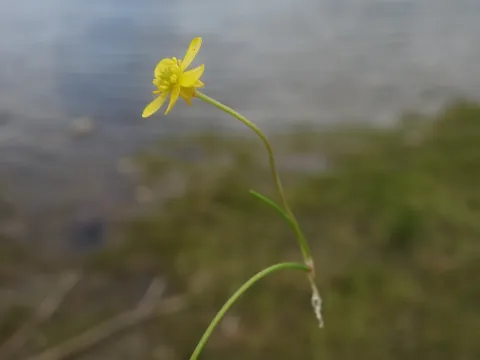
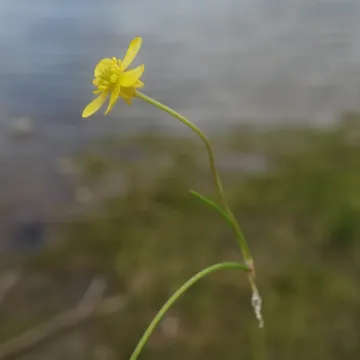
Creeping buttercup (Ranunculus reptans) is a perennial herbaceous plant belonging to the Ranunculaceae family. Unlike many upright buttercups, this specific species is recognized by its prostrate growth habit, featuring slender stems that root at the nodes, allowing the plant to spread effectively across moist or saturated soil surfaces.
The native range of Ranunculus reptans spans the temperate and arctic regions of the Northern Hemisphere, including vast territories in Eurasia and North America. It is typically found in wetland habitats, such as muddy shores, marshes, and periodically flooded meadows, where it thrives in niches that are often too challenging for less specialized vegetation.
Botanically, the plant is characterized by narrow, lanceolate leaves and small, solitary yellow flowers held on slender peduncles. The root system is primarily adventitious, developing from the nodes of the trailing stems, which provides the plant with an efficient method of nutrient absorption and stability in fluctuating water environments.
Regarding cultural requirements, the plant demands consistent soil moisture to maintain health. It prefers cool climates with high humidity levels and does not tolerate drought conditions. In an agricultural or horticultural context, providing a substrate that mimics its natural riparian habitat, rich in organic matter and permanently wet, is essential for its vegetative success.
From a utilization perspective, it is important to note that like many members of the genus Ranunculus, this plant contains protoanemonin, making it potentially toxic if ingested by livestock. Consequently, it is often managed as a weed in agricultural pastures. However, it holds value in ecological restoration projects, where its binding roots assist in soil erosion control along riverbanks and shoreline stabilization.
- Rapid vegetative spread through rooting stems.
- High demand for constant soil moisture.
- Presence of toxic compounds (protoanemonin).
- Excellent adaptation to riparian zones.
Photo gallery