Perennial bastard cabbage
Rapistrum perenne
Description
Perennial bastard cabbage (Rapistrum perenne) is a herbaceous perennial plant belonging to the Brassicaceae family. In agronomy, it is recognized for its robustness, versatility, and ability to thrive in challenging environmental conditions where more sensitive forage crops might fail to produce consistent biomass.
Originating from Central and Southeastern Europe and parts of Western Asia, this species is naturally adapted to dry, open habitats. Its evolutionary history in steppe-like environments has equipped it with strong drought resistance and the ability to establish itself in soils with varying nutritional profiles.
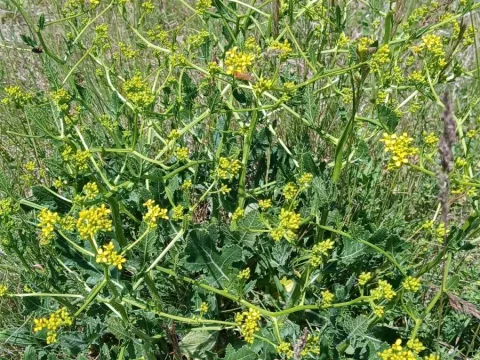
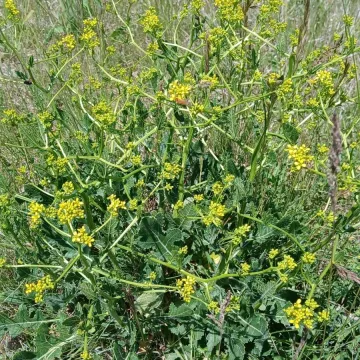
Botanically, the plant is characterized by a deep taproot and a branched stem that can reach significant heights. Its foliage is lyrate, and it produces bright yellow, cruciform flowers arranged in racemes. The distinct fruit is a two-segmented pod, a key feature for identifying the species during its reproductive phase.
The crop thrives in well-drained, neutral to slightly alkaline soils. It requires full sunlight to optimize its growth rate and yield. Agronomic management involves careful weed control during the seedling stage, as the plant grows relatively slowly at first. Once established, it requires minimal intervention, though potassium-rich fertilizers can significantly improve its overwintering capacity.
Economic applications for this crop are primarily focused on forage production:
- Grazing and hay production for livestock.
- Stabilization of soil in erosion-prone areas.
- Use in mixed forage stands to enhance drought resilience.
The crop is susceptible to common Brassicaceae pathogens, such as downy mildew and alternaria leaf spot, particularly under high-humidity conditions. Pest management focuses primarily on controlling crucifer flea beetles and various leaf beetles. Integrated pest management strategies, including crop rotation and monitoring, are essential to maintain crop health and yield quality.
Photo gallery