Red hesperaloe
Hesperaloe parviflora (Torr.) J. M. Coult.
Description
Red hesperaloe (Hesperaloe parviflora) is a long-lived, evergreen perennial plant belonging to the Agavaceae family (often categorized within Asparagaceae). Often mistaken for an aloe species due to its common name and leaf structure, it is actually a distinct genus native to the Chihuahuan Desert and surrounding regions of Texas and Mexico, renowned for its toughness and aesthetic appeal.
The plant originates from the arid regions of the southwestern United States and northeastern Mexico. Its natural habitat is defined by rocky soils, intense heat, and infrequent rainfall. Because of this evolutionary background, the species is perfectly adapted to surviving prolonged droughts and high-temperature environments where traditional garden plants would fail to thrive.
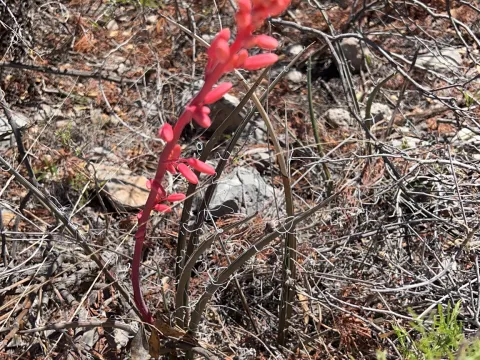
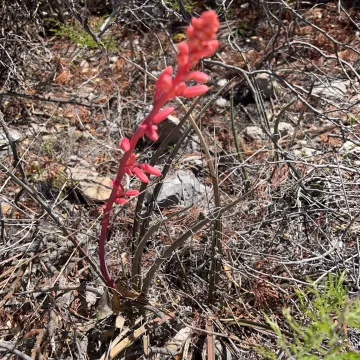
Botanically, red hesperaloe forms a dense, clumping rosette of leathery, sword-shaped leaves that can reach a height of three to four feet. The primary horticultural merit lies in its tall, arching flower spikes. These spikes emerge from the center of the rosette, producing abundant coral-red or pinkish tubular flowers that bloom consistently from late spring through the heat of summer and into autumn.
In terms of agricultural and horticultural requirements, this species is extremely low-maintenance once established. It thrives in well-draining, gritty, or rocky soils with neutral to slightly alkaline pH. It is a full-sun plant; shading will lead to etiolation and a significant reduction in flower production. Irrigation should be applied only during the establishment phase, after which it can survive on minimal natural precipitation.
Its primary agricultural and landscape uses include:
- Xeriscaping and water-wise landscape design;
- Erosion control on rocky slopes or hillsides;
- Low-maintenance municipal and roadside landscaping;
- Pollinator-friendly gardens (specifically attracting hummingbirds);
- Container gardening in Mediterranean-style climates.
The plant is remarkably resistant to typical pests and diseases. However, the most significant risk to its health is crown or root rot, which is almost exclusively caused by overwatering or poorly drained, heavy clay soils. Ensuring proper aeration and avoiding water accumulation around the base of the rosette are critical for longevity. When grown under appropriate environmental conditions, the plant is virtually immune to standard agricultural pests.
Photo gallery