Firebush
Hamelia patens Jacq.
Description
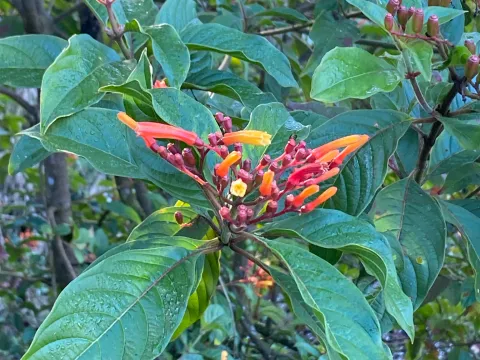
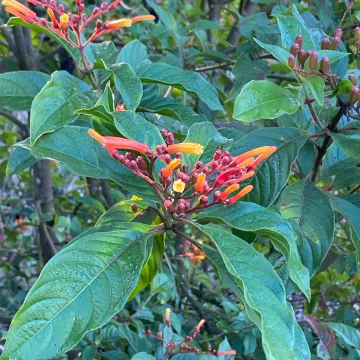
Firebush, scientifically known as Hamelia patens Jacq., is a prominent member of the Rubiaceae family. This perennial shrub is highly valued for its continuous display of tubular, orange-to-red flowers and its ability to thrive in warm climates. It serves as a staple in many tropical and subtropical gardens due to its hardiness and ornamental appeal.
The native distribution of Hamelia patens spans from the southern United States through Mexico and Central America into South America. It has successfully naturalized in many similar climates worldwide. As an agricultural and ornamental crop, it prefers frost-free environments, although it can be grown as an annual or container plant in cooler regions.
Botanically, the firebush is characterized by its whorled leaves and distinct cluster inflorescences. The plant can reach significant heights, often functioning as a large shrub or small tree. Its fruit is a small berry that matures to a dark purple or black color, serving as a vital food source for avian species, which is a key ecological feature of the plant.
Cultivation requires well-draining soil and exposure to full sun, although the plant shows some adaptability to partial shade. The species is relatively drought-tolerant once established, but it thrives best with consistent moisture levels. Regular pruning is essential to manage its rapid growth habit and to encourage a bushier structure with more abundant flowering.
- Ensure soil is amended with organic matter for better drainage.
- Apply balanced fertilizers during the primary growing season to boost flower production.
- Monitor for common pests such as whiteflies or scale insects.
- Prune back significantly in early spring to control size and shape.
Economically, Hamelia patens is widely used in landscape design for ecological restoration, butterfly gardening, and hedging. Beyond its aesthetic value, it holds ethnobotanical significance in its native regions, where various plant parts have been historically used in traditional medicinal practices. Its role as a major nectar source makes it indispensable for biodiversity management.
Photo gallery