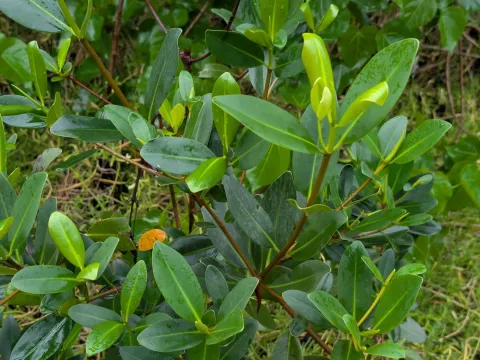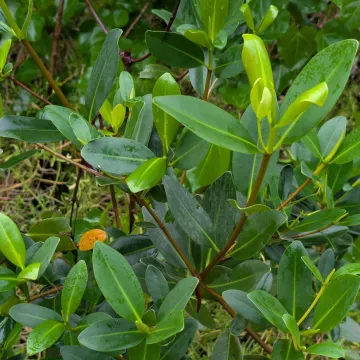
Red mangrove
Rhizophora mangle L.
Description
Rhizophora mangle L., commonly known as the Red mangrove, is a foundational species of the Rhizophoraceae family. It is a highly specialized evergreen tree evolved to thrive in the intertidal zones of tropical and subtropical regions, serving as a pillar for coastal biodiversity and shoreline protection.
The native range of this species extends across the Atlantic coasts of the Americas, the Caribbean, and West Africa. As a true halophyte, the plant possesses sophisticated biological adaptations to filter salt through its roots and expel it through its leaves, allowing it to flourish in environments that would be toxic to most terrestrial vegetation.
Botanically, the plant is famous for its intricate system of prop roots, which provide stability in soft, anaerobic marine sediments. It also exhibits vivipary, where the embryo develops into a propagule while still attached to the parent tree, increasing its chances of survival once it detaches and drifts into the currents to colonize new tidal areas.
Regarding agrotechnical requirements, the Red mangrove demands constant contact with saline water, high humidity, and consistent tropical temperatures. Restoration efforts focus on transplanting healthy propagules into designated intertidal mudflats, carefully managing the water flow and sediment depth to ensure successful root establishment.
Economically, the species is valued for its tannin-rich bark, high-quality durable wood, and its role in protecting local fisheries. Management of health issues in these stands involves monitoring for potential threats:
- Boring insects that target the stilt roots and trunks.
- Leaf-eating caterpillars capable of defoliating entire stands.
- Fungal infections that thrive in stagnant, poorly circulated water conditions.
Photo gallery