Marsh Labrador tea
Rhododendron tomentosum
Description
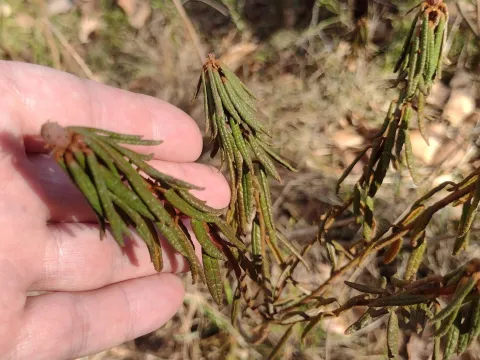
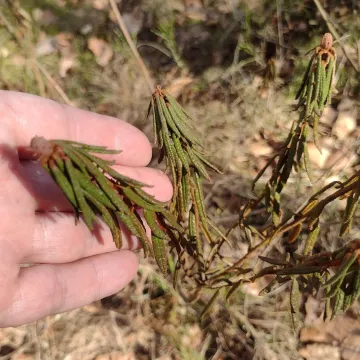
Marsh Labrador tea (lat. Rhododendron tomentosum), previously known as Ledum palustre, is an evergreen shrub belonging to the Ericaceae family. It is a slow-growing perennial that typically reaches a height of 20 to 120 cm. The plant is well-known for its strong, pungent aroma caused by high concentrations of essential oils, including ledol, which are present throughout its foliage and stems.
The natural range of this species spans the boreal regions of the Northern Hemisphere, including Northern Europe, Northern Asia, and North America. It thrives in nutrient-poor, acidic conditions such as peat bogs, swampy forests, and marshlands. Because of its specific ecological requirements, it is grown in controlled settings primarily for medicinal research and specialized botanical collections.
Botanically, the plant is characterized by leathery, linear-oblong leaves with margins that curl downwards. The underside of the leaf is covered in a dense, rust-colored tomentose (woolly) pubescence, which serves as an adaptation to retain moisture. The white flowers, which appear in late spring, are arranged in terminal umbel-like clusters and are highly fragrant, often attracting various pollinators.
Cultivation requires replicating the acidic, water-logged, yet well-drained environment of a bog. The soil must be highly acidic, with a pH range between 3.5 and 5.0, consisting mainly of sphagnum peat or specialized ericaceous compost. The plant possesses a shallow root system that relies heavily on mycorrhizal associations, making it sensitive to synthetic fertilizers and alkaline water sources.
The primary economic and agricultural use of the plant involves the extraction of essential oils for the pharmaceutical industry, where it is utilized for its expectorant and anti-inflammatory properties. Beyond medicine, the plant's natural insect-repelling properties have historically been utilized to protect stored goods and dwellings from moths and other insects. Proper harvesting techniques and safety precautions are essential due to the plant's toxic potential.
- Ensure the soil pH remains strictly acidic.
- Avoid using tap water containing lime or chlorine.
- Maintain high air humidity through misting.
- Provide light shade to protect the plant from midday sun.
Photo gallery