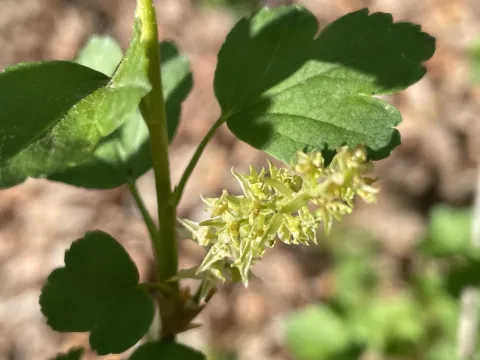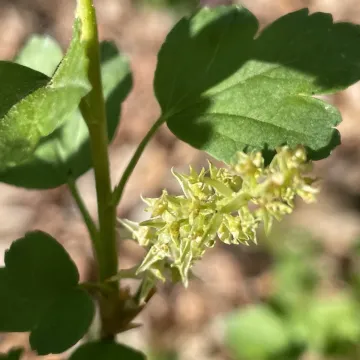
Alpine currant
Ribes alpinum
Description
Alpine currant (Ribes alpinum) is a deciduous, multi-stemmed shrub belonging to the Grossulariaceae family. Unlike its relative, the blackcurrant, this species is cultivated primarily for its ornamental value and its exceptional tolerance to hedging, making it a staple in both public and private landscape projects across temperate regions.
Originating from the mountainous regions of Europe and parts of Western Asia, this plant is remarkably hardy. It is well-adapted to cold climates and rocky soils, allowing it to thrive in conditions where many other ornamental shrubs would struggle. Its widespread distribution across Europe testifies to its resilience and adaptability.
From a botanical perspective, the plant is characterized by a dense, slow-growing habit and glossy, three-lobed leaves that emerge early in the spring. It produces small, greenish-yellow flowers in late spring, followed by bright red, tasteless berries. The plant's architectural density is its primary aesthetic feature, especially when managed with regular pruning.
Agronomic requirements are relatively low, as Ribes alpinum prefers fertile, well-drained soil but can easily tolerate clay or chalky substrates. It is known for its shade tolerance, which is unusual for many fruiting shrubs, and its high resistance to air pollution, making it an excellent choice for urban hedging and street-side planting.
- Regular pruning is essential for dense hedge formation.
- The plant is generally resistant to pests.
- Can be propagated by cuttings or seeds.
- Thrives in full sun to partial shade.
- Requires minimal fertilization once established.
Regarding health management, the alpine currant is occasionally susceptible to leaf spot diseases or aphids if the plant is overly dense or stressed by drought. Proper maintenance, including annual thinning to improve airflow and adequate water during dry spells, usually ensures a healthy and long-lived shrub without the need for extensive chemical treatments.
Photo gallery