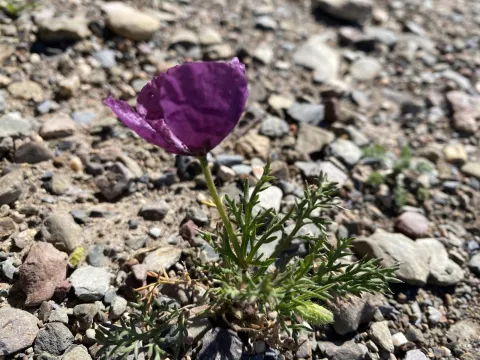

Violet horned poppy
Roemeria hybrida
Description
The violet horned poppy (Roemeria hybrida) is an annual herbaceous plant belonging to the poppy family (Papaveraceae). Often categorized as a weed, this plant is notable for its vivid violet-purple flowers and its resilience in challenging environmental conditions, particularly in arid and semi-arid agricultural landscapes.
The species is native to the Mediterranean region, Western Asia, and Southern Europe. It thrives in open, sunny habitats, including arable fields, rocky slopes, and roadsides. Its geographical distribution is closely tied to its ability to colonize dry, disturbed soils where competition from other vegetation is relatively low.
Botanically, Roemeria hybrida is characterized by its pinnatisect leaves and distinct tetramerous flowers. The most recognizable feature is its slender, elongated seed capsule that resembles a horn, from which the common name is derived. The plant typically reaches a height of 15 to 40 centimeters during its active growing season.
Agronomically, the plant is viewed as a persistent weed that competes with cereal crops for water and nutrients. Effective management strategies involve mechanical weeding during the early stages of growth and the application of selective herbicides in cereal fields to prevent seed bank formation, as the plant reproduces exclusively by seed.
Economically, the violet horned poppy has limited utility and is generally considered undesirable due to its potential toxicity caused by alkaloid content, which makes it unsuitable for livestock forage. While not a commercial crop, it remains a subject of interest in ecological studies and weed control research due to its adaptability.
Photo gallery