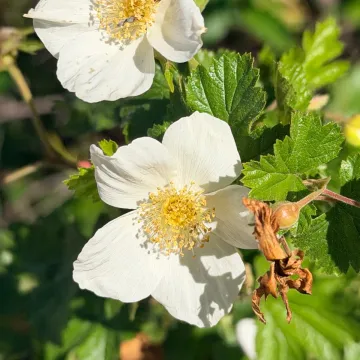

Rocky Mountain raspberry
Rubus deliciosus
Description
Rocky Mountain raspberry (Rubus deliciosus) is a deciduous shrub belonging to the Rosaceae family. Unlike its commercial relatives cultivated for fruit production, this specific species is primarily valued as an ornamental plant due to its spectacular flowering display and graceful growth habit. It is naturally thornless, making it an excellent candidate for public gardens and residential landscaping.
The native habitat of Rubus deliciosus is centered in the central Rocky Mountains of North America, particularly across Colorado, Wyoming, and New Mexico. It thrives in high-altitude conditions, often inhabiting rocky outcrops and forest edges. This evolutionary history provides the plant with exceptional hardiness, allowing it to withstand extreme temperature fluctuations and lean soil conditions.
Botanically, the plant presents as an arching, rounded shrub typically ranging from 1.5 to 2.5 meters in height. Its foliage consists of palmately lobed leaves that provide a lush appearance throughout the growing season. The most striking feature is its large, single white flowers with prominent yellow centers that bloom in late spring, creating a visual impact similar to that of a wild rose.
Regarding soil and climatic requirements, this species demands well-drained soil with excellent aeration. It performs poorly in heavy clay or waterlogged areas, which can lead to root rot. While it is drought-tolerant once established, supplemental irrigation during the first two years of growth is crucial for developing a strong root system. The shrub prefers full sun to partial shade exposures to maximize floral production.
While the fruit is botanically edible and sweet, it is relatively small and dry, which limits its culinary use. Instead, the plant is widely utilized for erosion control on slopes and as a structural element in native plant gardens. Management involves minimal pruning, focusing on the removal of old or dead wood after the flowering period, and keeping a close watch for pests like aphids or fungal issues in humid environments.
Photo gallery