Mysore raspberry
Rubus niveus
Description
Mysore raspberry (Rubus niveus) is a perennial shrub belonging to the Rosaceae family. It is distinct for its arching, white-bloomed stems that give the plant a frosted or "snowy" appearance, from which its scientific name is derived. As a vigorous grower, it can reach significant heights, making it a prominent feature in both wild and cultivated settings.
The plant is native to the high-altitude regions of Southeast Asia, specifically spanning from the Himalayas to parts of China and India. Because of its origin, it is well-adapted to cooler climates and varying altitudes, showing remarkable resilience in mountainous terrain. This evolutionary adaptation makes it a robust choice for growers in similar environments.
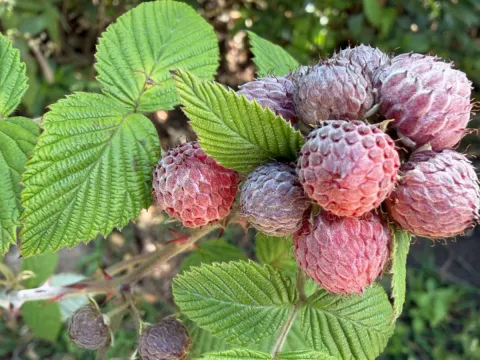
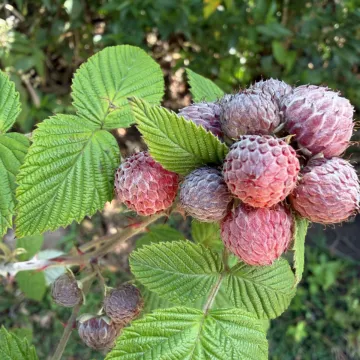
Botanically, Rubus niveus is characterized by its serrated leaves and small, fragrant flowers that develop into clusters of dark-colored drupelets. The berries transition from a bright red stage to a deep purple or near-black color upon full maturity. They possess a sweet-tart flavor profile, which is highly appreciated in regions where this fruit is commonly found and consumed.
Regarding cultivation requirements, the plant thrives in fertile, well-draining soils with a slightly acidic to neutral pH. It demands full sun exposure to maximize fruit production and sweetness. Growers must implement regular pruning practices to remove old canes, which helps maintain plant vigor, improves airflow, and reduces the risk of common fungal diseases.
- Prefers moderate watering throughout the growing season.
- Requires trellising or support to manage its long, arching canes.
- Benefits from organic mulch to retain soil moisture and suppress weeds.
- Needs protection from severe frost in colder latitudes.
In terms of economic usage, the Mysore raspberry is popular for fresh consumption, as well as for processing into jams, jellies, and desserts. Beyond its culinary appeal, it serves as an important genetic resource for breeding programs aimed at improving the hardiness and disease resistance of various Rubus cultivars, making it a valuable subject for agricultural research.
Photo gallery