Holy blackberry
Rubus sanctus
Description
Holy blackberry (Rubus sanctus) is a hardy perennial shrub belonging to the Rosaceae family. It is well-known for its vigorous growth and is often identified as one of the wild relatives of modern cultivated blackberries. In agricultural and environmental contexts, it is valued for its resilience and its role in protecting soil structures.
The plant originates from the Eastern Mediterranean, Middle East, and parts of the Caucasus. Its natural habitat includes rocky slopes, riverbanks, and woodland fringes. Due to its evolutionary history, it is exceptionally adapted to semi-arid climates, allowing it to survive in regions where other berry crops might fail due to water stress.
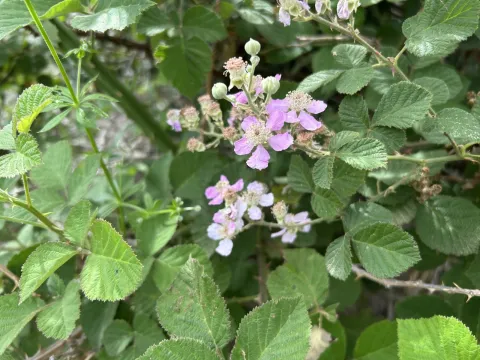
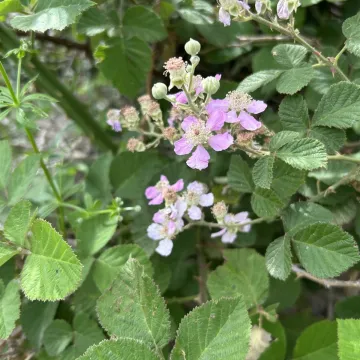
Botanically, Rubus sanctus is characterized by arching or prostrate stems armed with strong, recurved prickles. Its leaves are palmately compound, often with a white or greyish tomentose underside. The flowers, which bloom in the summer, feature white or pale pink petals, while the fruit is an aggregate of drupelets that turns black upon reaching maturity.
Cultivation requirements for this species focus on site selection and maintenance. It thrives in full sun but can tolerate partial shade. While it is drought-tolerant, providing consistent moisture during the fruit-set phase significantly enhances yield. Soil preference lies in well-drained loams or sandy soils, though it shows impressive tolerance for rocky, poor-quality terrain.
Economically, this species is utilized as a source of nectar for beekeeping and as a traditional herbal remedy, with various parts of the plant used for their astringent properties. Its aggressive growth habit also makes it a practical choice for creating natural, impassable biological fences and preventing soil erosion on slopes.
- High environmental adaptability to dry climates.
- Excellent biological barrier due to dense, thorny growth.
- Source of forage for pollinators throughout the summer.
- Robust root system that stabilizes unstable soils.
- Minimal requirements for chemical fertilizers or pest control.
Photo gallery