Veiny dock
Rumex venosus
Description
Veiny dock (Latin: Rumex venosus) is a distinctive perennial herb belonging to the Polygonaceae family. Unlike common sorrel, this species is uniquely adapted to thrive in harsh, dry environments, specifically favoring sandy substrates where few other plants can establish a foothold.
The species is native to North America, particularly widespread throughout the Great Plains and the desert regions of the West. It is naturally found in dunes, sandy river banks, and open prairie habitats. Its evolutionary history has equipped it with deep rhizomes, which are essential for survival in environments characterized by shifting sands and infrequent rainfall.
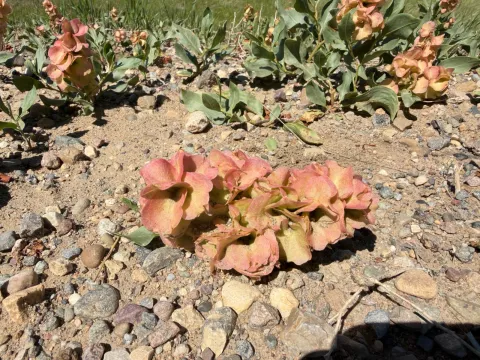
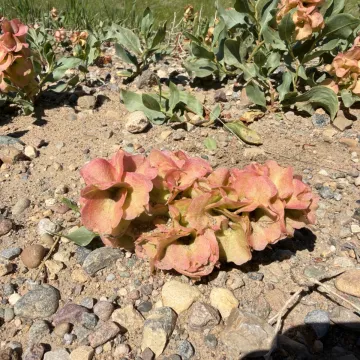
Botanically, Rumex venosus is recognized by its erect stems reaching up to half a meter in height. The foliage is thick and prominently veined, which serves as a key identifying characteristic. Perhaps the most striking feature is the large, showy, pink-to-reddish winged valves (bracts) that encase the fruit, providing a visual spectacle during the late summer season.
Cultivation requirements for this species are centered on extreme drainage. It thrives in full sun and loose, gravelly, or sandy soils. It is highly drought-tolerant once established and does not require fertilization. Gardeners or agriculturalists looking to grow this plant should avoid areas with heavy clay or poor drainage, as these conditions rapidly lead to root decay.
In terms of agricultural and ecological use, veiny dock is primarily valued for land restoration. It is an excellent candidate for stabilization projects on sandy slopes, industrial sites, or eroded dune systems. Additionally, it serves as a niche plant for xeriscaping, offering both structural integrity for the soil and aesthetic value through its colorful, ornamental seed pods.
The plant is relatively resilient to typical pests and diseases. While it may occasionally face pressure from aphids or localized fungal leaf spots under humid conditions, it usually does not require chemical intervention. Its primary management entails monitoring its spread, as the rhizomatous nature of the plant allows it to colonize available space quite aggressively.
Photo gallery