Fringed rue
Ruta chalepensis
Description
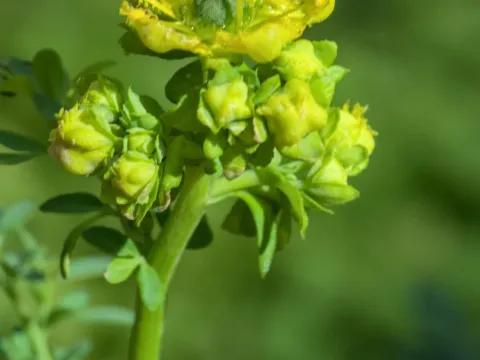
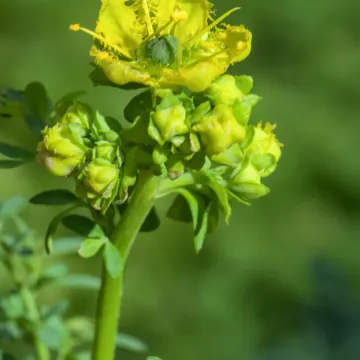
Fringed rue (Ruta chalepensis) is a perennial subshrub belonging to the Rutaceae family. Distinguishable by its deeply divided, lacy foliage and distinctive yellow flowers, this plant has been valued for centuries both as a medicinal herb and an ornamental addition to gardens. It contains unique phytochemicals and essential oils that make it a subject of interest in pharmaceutical research.
The native range of this species extends across the Mediterranean basin and the Middle East, particularly in the regions of the Levant. Adapted to harsh, arid environments, the plant thrives in rocky, well-drained soils and is highly resistant to heat and drought. Historically, it has been used in various traditional practices, which has facilitated its distribution to other warm-climate regions globally.
Botanically, Fringed rue is characterized by a woody base and reaching heights of up to 80 centimeters. Its leaves are tripinnate, glaucous, and covered with pellucid oil glands, which give the plant its characteristic pungent aroma. The flowers, appearing in terminal cymes, have fringed petals, a key morphological feature that distinguishes it from the common rue, Ruta graveolens.
From an agricultural standpoint, the plant requires full sun and excellent drainage. It does not tolerate waterlogged soils, which can quickly lead to root rot. Successful cultivation involves planting in light, alkaline soils and providing minimal irrigation after establishment. Harvesting is typically done during the flowering period to maximize the yield of volatile oils.
Industrial and commercial applications include:
- Extraction of essential oils for fragrance and traditional remedies.
- Pharmaceutical production of compounds with antispasmodic properties.
- Ornamental landscaping for drought-tolerant or xeriscape gardens.
- Use as a natural pest repellent in surrounding garden beds.
While relatively hardy, Fringed rue can be susceptible to aphids and spider mites, especially in dry weather conditions. Fungal diseases such as root rot are the primary threat, usually caused by improper soil management or excessive humidity. Growers are advised to practice crop rotation and ensure proper air circulation to mitigate these risks effectively.
Photo gallery