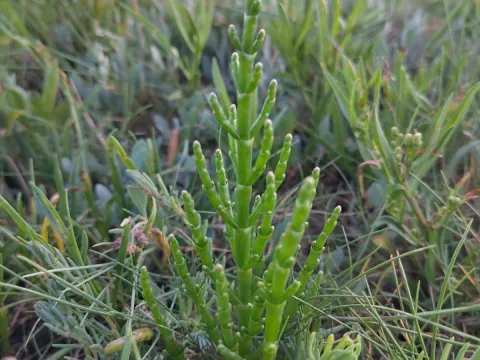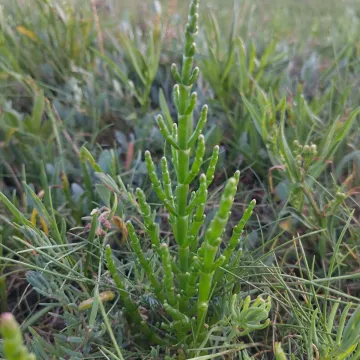
Common glasswort
Salicornia europaea
Description
Common glasswort (Salicornia europaea) is a unique succulent annual plant belonging to the Amaranthaceae family. It is a highly specialized halophyte, an organism evolved to thrive in environments with high salinity levels. Unlike conventional crops, this plant utilizes salt to maintain its internal osmotic balance and metabolic functions, making it a pioneer species for saline habitats.
The natural range of the species covers coastal marshes, salt flats, and intertidal zones across Europe, Asia, and North America. It acts as an indicator species for saline lands. Due to its physiological adaptation, common glasswort can colonize areas that are unsuitable for traditional agriculture, which makes it a subject of increasing interest for sustainable land management and saline farming strategies.
Botanically, the plant features succulent, jointed stems that lack traditional foliage, with leaves reduced to tiny scales. During its development, the plant transitions from a bright green color to a deep red or purple hue as it accumulates pigments and salts. The root system is relatively shallow, designed to extract moisture efficiently from saline environments, while the succulent stems store water to survive periods of evaporation.
Agricultural requirements for common glasswort include constant access to moisture and a saline-rich substrate. Farmers often use saline or brackish water for irrigation, which distinguishes this crop from traditional vegetables. The plant demands full sun exposure and well-drained soil. Because of its unique cellular composition, it exhibits high resistance to common crop pathogens and insect pests, reducing the need for chemical plant protection products during the growing cycle.
Commercial utilization of the species is growing rapidly in several sectors. In the culinary industry, it is marketed as "sea asparagus," prized for its crisp texture and salty, mineral-rich flavor. Beyond nutrition, the plant is investigated for its potential to yield oil from seeds, which can be processed into food-grade oil or biofuel. Additionally, it plays a vital role in phytoremediation, helping to desalinate agricultural soils through natural uptake mechanisms.
- Extreme salt tolerance for unconventional farming.
- High nutritional profile with iodine and essential minerals.
- Minimal requirement for chemical pest management.
- Potential as a source for sustainable biofuel production.
- Ability to reclaim saline lands through phytoremediation.
Photo gallery