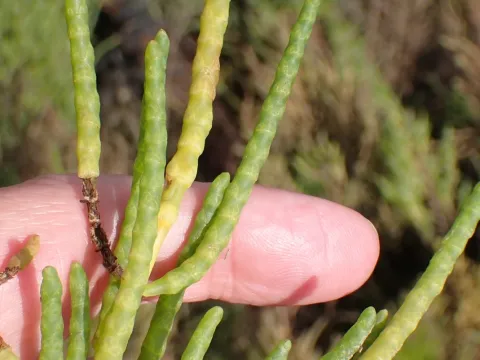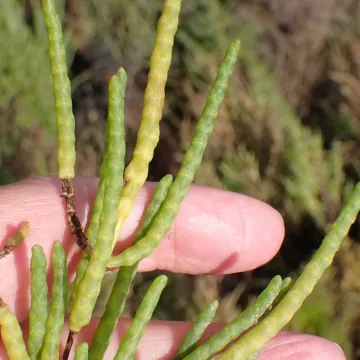
Sprawling saltwort
Salicornia procumbens
Description
Sprawling saltwort (Salicornia procumbens) is an annual herbaceous plant belonging to the Amaranthaceae family. It is a specialized halophyte, an organism that thrives in saline environments that would be toxic to conventional crops. This physiological adaptation makes it a vital subject for agricultural projects aimed at utilizing saline soils and coastal regions that are otherwise unfit for food production.
The plant originates from coastal areas of Europe and Asia, where it naturally colonizes salt marshes and saline wetlands. Its natural distribution spans across temperate and subtropical regions. In modern agriculture, it is increasingly seen as a sustainable model for saline-alkaline land reclamation, offering a way to restore productivity to degraded landscapes.
Botanically, Salicornia procumbens is defined by its succulent, jointed stems that lack traditional leaves. Its morphology is perfectly adapted for osmotic stress, allowing it to sequester salt in its vacuoles. This biochemical mechanism prevents the buildup of harmful salt levels in the cytoplasm, enabling the plant to maintain turgor pressure even when growing in saturated saline solutions.
Regarding cultivation requirements, the plant demands consistent sunlight and irrigation with water of varying salinity. Unlike traditional agriculture, fertilization needs are minimal, as the plant extracts nutrients efficiently from poor saline soils. Proper water management is essential to prevent waterlogging, as the root system requires adequate aeration even in high-salt substrates to promote vigorous growth.
The economic value of this crop is significant and growing. Its culinary use as a salty vegetable—often termed "sea asparagus"—is popular in gourmet cuisine. Furthermore, its seeds are rich in high-quality oils, making it a viable candidate for biofuel production. In the field, it suffers from very few pests or diseases due to the inhibitory nature of its saline environment, making it an excellent candidate for organic farming practices in specific coastal zones.
Photo gallery