Black sage
Salvia mellifera
Description
Black sage (Salvia mellifera) is a perennial evergreen shrub belonging to the Lamiaceae family. It is a defining species of the chaparral plant community, recognized for its adaptability to challenging, resource-scarce environments.
Native to the coastal ranges of California and Baja California, this species thrives in a Mediterranean climate. Its distribution is naturally limited to regions with mild, wet winters and long, hot, rainless summers, where it dominates exposed rocky slopes.
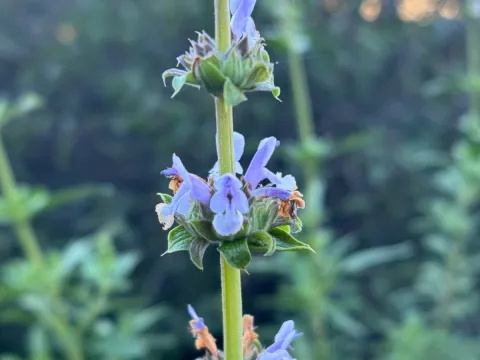
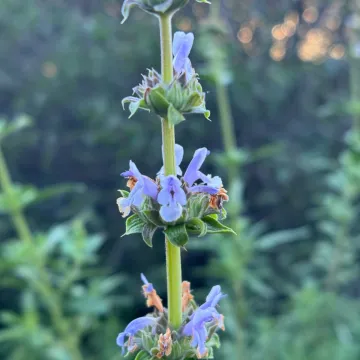
Morphologically, the plant grows as a densely branched shrub reaching heights of 1 to 1.5 meters. It is characterized by dark green, wrinkled leaves and distinct clusters of small, pale blue to lavender flowers, which are highly attractive to bees and other pollinators.
Agronomic success with Salvia mellifera depends on providing well-draining, coarse-textured soils with neutral or alkaline pH. It is a highly drought-tolerant crop that requires very little water once established; excessive soil moisture is the primary cause of root rot in agricultural settings.
Economic and practical applications include:
- Premier honey production, favored by beekeepers for its sweet, distinctively flavored nectar.
- Erosion control in restoration projects due to its deep and effective root system.
- Xeriscaping and ornamental usage in low-water gardens.
Regarding health management, the crop is generally hardy, though it may encounter issues with powdery mildew during periods of high humidity. Aphids are the most common insect pest; maintaining good airflow through pruning is the most effective preventative cultural practice.
Photo gallery