Sasa palmata
Sasa palmata
Description
Sasa palmata, commonly known as the broad-leaved bamboo, is a perennial evergreen plant belonging to the Poaceae family, subfamily Bambusoideae. This species is highly valued in horticulture for its distinctively wide, palm-like leaves that create a lush, tropical appearance despite its ability to thrive in temperate climates. It is characterized by its aggressive spreading habit, driven by a vigorous rhizome system.
The plant originates from East Asia, specifically Japan, Sakhalin, and the Kuril Islands. It is naturally adapted to cool, moist environments and is frequently found in understory habitats where it forms dense, monospecific stands. Its native distribution indicates a tolerance for varied soil conditions and a preference for regions with consistent moisture throughout the growing season.
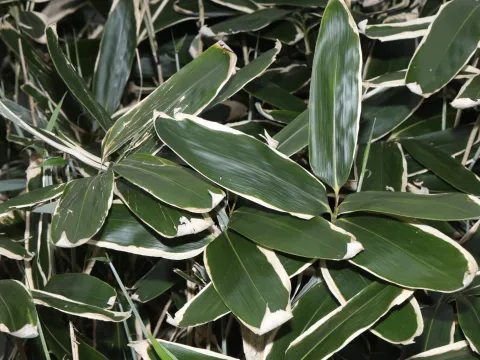
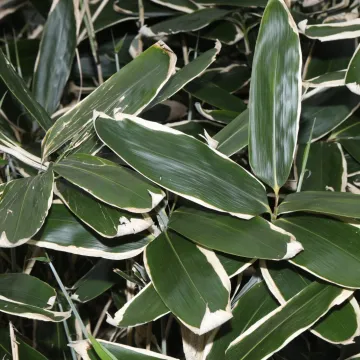
Botanically, Sasa palmata features culms (stems) that typically grow between 1 to 2 meters in height. The foliage is the plant's primary feature, with leaves reaching up to 30 cm in length. These leaves are thick and leathery, providing a significant visual mass. During the late autumn and winter months, the leaf edges often develop a distinctive white or straw-colored margin, adding to its ornamental appeal.
Cultivation requirements involve selecting a location with partial shade to filtered light to prevent leaf scorching. The soil must be well-drained, rich in organic matter, and kept consistently moist. Because of its invasive rhizomatous nature, commercial and garden cultivation necessitates the use of subterranean barriers to contain the spread. Spring fertilizing with high-nitrogen compost promotes vigorous leaf production.
In landscaping, Sasa palmata is used extensively as a ground cover for large areas or as a naturalistic screen. Regarding plant health, it is generally robust but can be susceptible to spider mites in dry conditions or fungal infections if soil drainage is poor. Typical maintenance includes regular pruning of dead culms and strict monitoring of its expansion to maintain the integrity of surrounding plantings.
Photo gallery