Vandelli's saxifrage
Saxifraga vandellii
Description
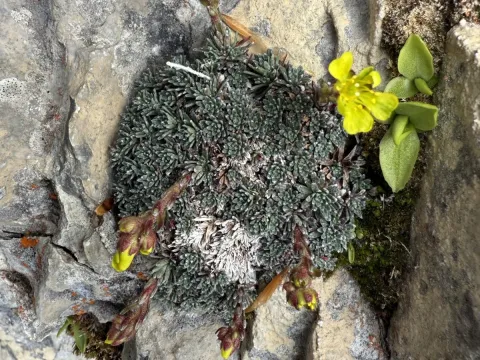
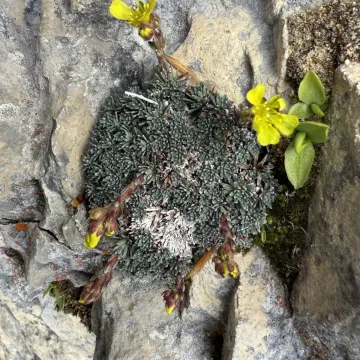
Vandelli's saxifrage (Latin: Saxifraga vandellii) is a perennial herbaceous plant belonging to the Saxifragaceae family. It is a specialized alpine plant renowned for its compact, cushion-forming growth habit. The plant is perfectly adapted to the harsh conditions of high altitudes, where it clings to vertical limestone surfaces, creating dense, silver-gray mats of foliage.
The native range of this species is confined to the limestone cliffs of the Eastern Alps, primarily in Italy. Because of its specific evolutionary adaptation to limestone crevices, it requires highly specialized conditions to thrive in a domestic garden setting. It is highly valued by plant enthusiasts as a focal point for alpine collections and rock gardens.
Botanically, Vandelli's saxifrage is characterized by its slow growth and rigid, leathery leaves that often exhibit calcium carbonate deposits, giving them a distinct white-spotted appearance. During its flowering season, usually in spring, the plant produces short, sturdy stalks bearing elegant white to cream-colored flowers arranged in compact clusters.
The cultivation requirements are strict: excellent drainage is the absolute priority to prevent root rot. A gritty, mineral-based, alkaline substrate is essential for the long-term survival of the plant. Gardeners should aim to plant it in a vertical orientation, such as within a crevice in a rockery, to prevent water from accumulating in the center of the leafy rosettes, which can cause severe decay.
- Strict requirement for sharp, fast-draining mineral soil.
- Placement in vertical rock crevices to minimize crown rot.
- Protection from intense, direct midday summer sun.
- Avoidance of winter moisture accumulation on the foliage.
- Careful propagation via offsets or seed in specialized conditions.
In terms of agricultural and horticultural use, the species is exclusively ornamental. It serves as a masterpiece in rock gardens and crevice plantings. While generally resistant to most pests, the primary threat to its health remains improper irrigation leading to fungal infections. Proper air circulation and minimal humidity around the foliage are key to maintaining a healthy specimen.
Photo gallery