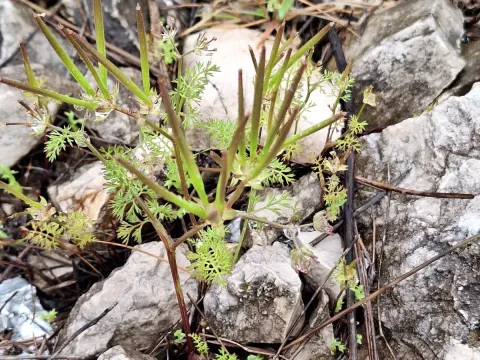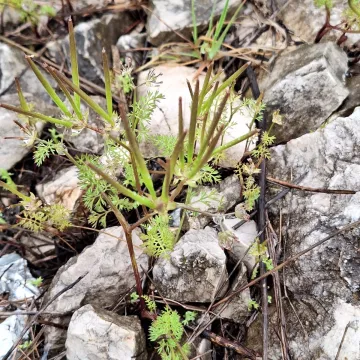
Southern shepherd's needle
Scandix australis
Description
Scandix australis, commonly known as the Southern shepherd's needle, is an annual herbaceous plant belonging to the Apiaceae family. This species is taxonomically distinct due to the elongated, needle-like beaks of its fruits, which serves as its primary diagnostic feature in both wild and cultivated settings.
The plant originates from the Mediterranean basin and Southern Europe. Its natural habitat consists of rocky slopes, meadows, and disturbed lands, where it has adapted to survive in environments with poor soil and irregular water availability. It prefers climates with mild winters and warm, dry spring seasons which facilitate its rapid life cycle.
Botanically, it features pinnate leaves and complex umbel inflorescences. The plant's structure is optimized for efficient seed dispersal, with the fruit pods acting as anchors in the soil. Its root system is primarily taproot-based, allowing the plant to reach deeper moisture reserves during the maturing phase of its vegetative cycle.
Agronomically, the crop requires well-drained, porous soils with a neutral or alkaline reaction. It is highly intolerant of waterlogging, which often leads to root rot. Successful cultivation involves sowing in well-prepared, friable soil during the dormant season, ensuring adequate spacing between rows to avoid competition for sunlight and nutrients.
The economic utility of the Southern shepherd's needle includes its use as a minor herbal or aromatic supplement. It is occasionally managed in organic systems due to its resilience to low-fertility conditions. Common pests include aphids and various species of spider mites, while fungal pathogens such as powdery mildew can occur if the local humidity levels exceed optimal thresholds for the crop.
Photo gallery