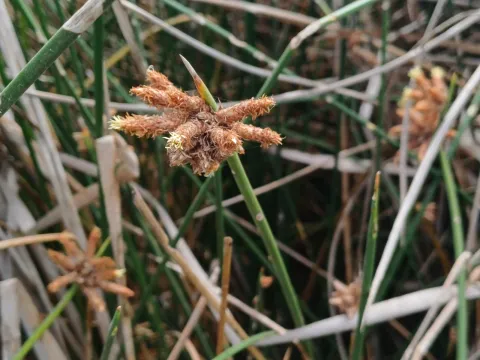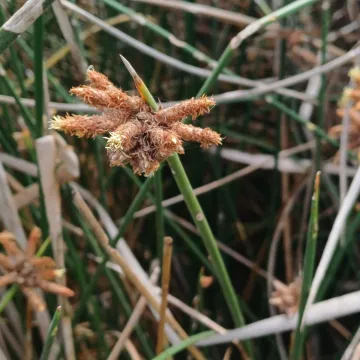
California bulrush
Schoenoplectus californicus
Description
California bulrush (Schoenoplectus californicus) is a prominent perennial herbaceous plant belonging to the Cyperaceae family. In agronomy, it is valued as a versatile aquatic crop that plays a critical role in ecological engineering and sustainable fiber production.
The plant is native to the Americas, ranging from the southern United States through Central America to South America. It thrives in marshes, riverbanks, and lake margins, showing a high level of environmental plasticity. Its ability to grow in both freshwater and brackish environments makes it a highly reliable species for cultivation in various wetlands.
Botanically, it features tall, cylindrical, and smooth stems that can grow up to 4 meters high. The plant spreads via vigorous underground rhizomes, which help stabilize riverbanks and control soil erosion. It produces small, brownish spikelets clustered in a terminal inflorescence, typical for members of the sedge family.
Cultivation requirements focus on hydrologic conditions. The plants need constant water saturation and perform best in nutrient-rich sediments. Planting is usually done via rhizome division during the dormant or early growth phase. Regular monitoring of water quality is essential, as the plant is sensitive to high levels of specific herbicides or heavy industrial pollutants.
Key areas of economic and agricultural use are as follows:
- Handcrafting and fiber production for traditional weaving and furniture making.
- Phytoremediation and wastewater treatment in agricultural drainage systems.
- Thermal and acoustic insulation materials for sustainable building construction.
- Habitat restoration for biodiversity and wildlife management.
Common issues include fungal infections that affect the stems during stagnant water conditions, potentially leading to widespread necrosis. Pests such as aphids and specialized stem-boring insects may cause damage during the peak growing season, necessitating integrated pest management strategies to maintain healthy crop yields.
Photo gallery