Drummond's rattlebush
Sesbania drummondii
Description
Drummond's rattlebush (lat. Sesbania drummondii) is a perennial woody shrub belonging to the Fabaceae family. It is often recognized by its feathery, pinnately compound leaves and clusters of bright yellow or reddish-orange flowers. While sometimes considered a weed, it is biologically significant for its role as a legume capable of nitrogen fixation in specific environmental niches.
The species is native to the southeastern United States, where it naturally inhabits floodplains, coastal areas, and the edges of freshwater marshes. Because of its ecological versatility, it has become well-established in various subtropical regions. Its presence is often marked by its ability to thrive in soil conditions that are periodically saturated with water, where other woody species might struggle.
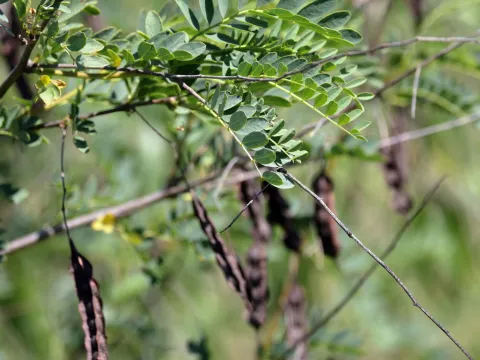
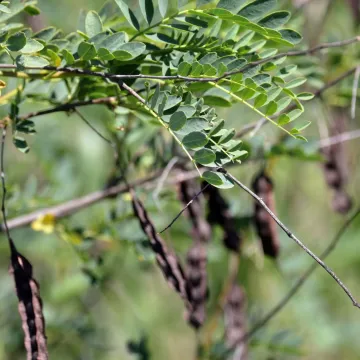
Botanically, Sesbania drummondii is characterized by its distinctively shaped, four-winged seed pods, which rattle in the wind—a feature that gives the plant its common name. The plant grows as a shrub, often reaching heights of up to 4 meters, with a main stem that can become quite thick and bark-like over several years of growth.
Cultivation requirements focus primarily on water availability and temperature. This species requires a long growing season without severe frosts. It thrives best in moisture-retentive soils and is highly efficient in adapting to riparian habitats. In an agricultural context, management requires careful monitoring to ensure that the plant does not escape into adjacent wild areas, as it can behave invasively.
The хозяйственное (economic) potential of the plant is balanced against its toxicity. All parts of the plant, especially the seeds, contain toxic saponins that are dangerous to livestock, causing significant health issues if ingested. Therefore, it is rarely used as forage. Instead, research focuses on its use as a biomass crop for fiber production or as a cover crop for soil remediation in non-grazing areas.
- Highly efficient nitrogen-fixing root systems.
- Adaptability to water-logged soil conditions.
- Requires warm climates with no killing frosts.
- Significant toxicity to domestic livestock.
- Potential use as a source of industrial fiber.
Photo gallery