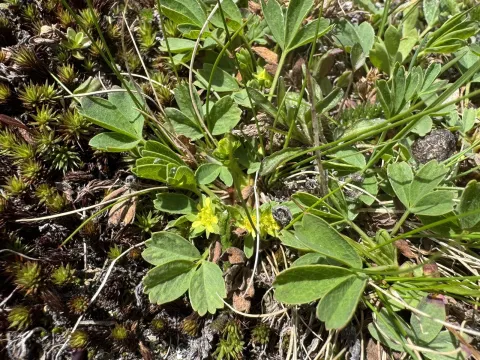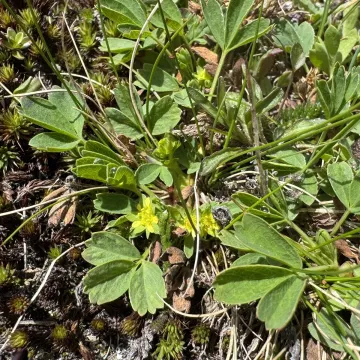
Sibbaldia procumbens
Sibbaldia procumbens
Description
Sibbaldia procumbens, commonly known as creeping sibbaldia, is a low-growing perennial herb belonging to the Rosaceae family. This species is taxonomically related to the Potentilla genus and is well-adapted to surviving in harsh, high-altitude environments. Its growth habit is primarily procumbent, forming dense mats that cling closely to the ground surface.
The natural distribution of this plant is circumpolar, found throughout the mountainous and arctic regions of the Northern Hemisphere, including parts of Europe, Asia, and North America. It thrives in alpine meadows, rocky slopes, and screes, where environmental conditions such as extreme temperature fluctuations and high winds are prevalent. It plays an important role in mountain ecosystem stability.
Botanically, Sibbaldia procumbens is characterized by its trifoliate leaves with serrated margins, often displaying fine hairs for moisture retention. The flowers are small, yellow to greenish-yellow, appearing in sparse clusters. The root system is shallow but highly efficient at anchoring the plant in rocky or thin soils, which is essential for survival in its rugged natural habitats.
Cultivation requirements for this species are specific: it necessitates cool temperatures, good drainage, and a substrate that mimics natural mineral soils. Over-fertilization, especially with nitrogen, should be avoided as it can cause leggy growth and susceptibility to rot. The plant performs best in sites with ample light and moderate humidity, making it challenging to grow in hot, lowland climates.
In agricultural and horticultural practices, Sibbaldia procumbens is primarily used as an ornamental groundcover for rock gardens and alpine displays. It is rarely bothered by pests or diseases in its native environment; however, in artificial conditions, root rot caused by poor soil drainage remains the main threat. Its biological traits, including cold-hardiness and resource efficiency, are of interest for genetic research into climate-resilient crops.
- Excellent choice for stabilizing slopes in alpine rock gardens.
- High tolerance for extreme frost and wind.
- Requires well-draining, mineral-rich soil.
- Requires minimal chemical intervention due to natural pest resistance.
Photo gallery