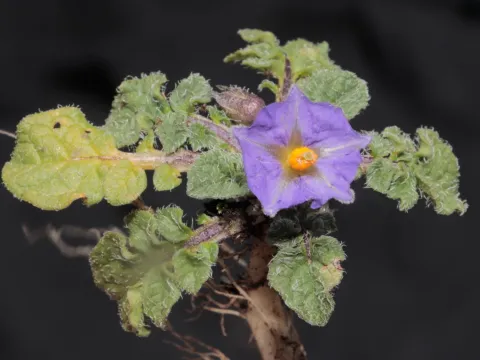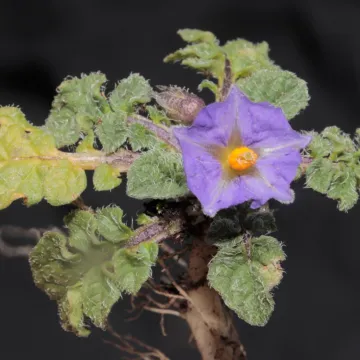

Stemless potato
Solanum acaule
Description
Stemless potato (Solanum acaule) is a wild herbaceous species belonging to the Solanaceae family. It serves as a crucial wild relative of the common potato, holding a significant position in botanical research and agricultural genetic banks.
The species originates from the high-altitude regions of the Andes, spanning across Peru, Bolivia, and northwestern Argentina. It thrives in extreme environments at altitudes reaching up to 4500 meters, where the low atmospheric pressure and harsh temperatures restrict most other vegetation.
Botanically, the plant is characterized by a rosetted growth habit where leaves grow close to the ground, effectively minimizing exposure to wind and cold. Unlike domestic potatoes, Solanum acaule produces small, thick-skinned tubers that contain significant levels of glycoalkaloids, rendering them largely unpalatable to humans.
This species is highly regarded for its remarkable frost tolerance, surviving temperatures as low as -8°C without suffering lethal damage. In terms of cultivation, it requires well-drained, sandy-loam soils and has a very specific photoperiodic response, making it difficult to maintain outside of controlled laboratory or greenhouse environments.
The primary economic and agricultural importance of Solanum acaule is its role in potato breeding. Breeders utilize its genome to introduce resistance to environmental stressors into commercial potato varieties. Like other members of its family, it is susceptible to various pests, including late blight and potato cyst nematodes, which require careful management in research collections.
- Exceptional frost resistance.
- Critical genetic resource for potato breeding.
- High-altitude native adaptation.
- Distinctive rosette morphology.
Photo gallery