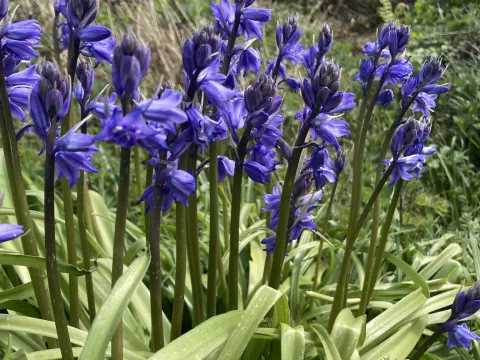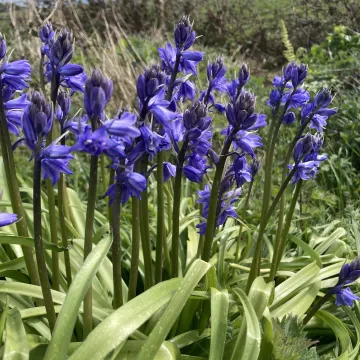
Spanish bluebell
Hyacinthoides hispanica (Mill.) Rothm.
Description
The Spanish bluebell (Hyacinthoides hispanica) is a perennial bulbous plant belonging to the Asparagaceae family. It is highly valued in horticulture for its resilience, ease of propagation, and the stunning bell-shaped flowers that appear in mid-to-late spring, creating vibrant displays in shaded garden areas.
Native to the Iberian Peninsula and parts of North Africa, the Spanish bluebell thrives in woodland settings and naturalized meadow conditions. Its historical range has expanded significantly due to its popularity as an ornamental plant, leading to its widespread introduction in temperate regions across the globe where it easily adapts to local soil and climate profiles.
Botanically, the plant features a robust bulb that produces narrow, strappy basal leaves and a sturdy flower spike. The spikes carry multiple pendulous flowers, which are typically blue, pink, or white. Unlike some other spring bulbs, the Spanish bluebell is known for its vigor and ability to self-seed and multiply into dense colonies over several years.
Agronomic requirements include well-draining, humus-rich soil and a location with partial to full shade, especially during the peak of the growing season. While the plants are hardy, they respond exceptionally well to organic mulch applied in the autumn, which preserves moisture and provides essential nutrients as the bulbs begin to wake up in early spring.
The practical application of Spanish bluebells in landscape management is versatile and impactful. Their primary uses involve:
- Naturalizing in woodland gardens or under deciduous trees;
- Adding vertical interest to spring-flowering borders;
- Softening the edges of pathways and rock garden features;
- Providing early season color in container arrangements.
Management of pests and diseases is relatively straightforward. The most significant threat is basal rot caused by poor soil drainage. In terms of biological control, ensuring proper spacing between bulbs is crucial for air circulation. While generally avoided by deer and rabbits, bulb-damaging insects may occasionally require attention through soil preparation and the selection of healthy, disease-free planting stock.
Photo gallery