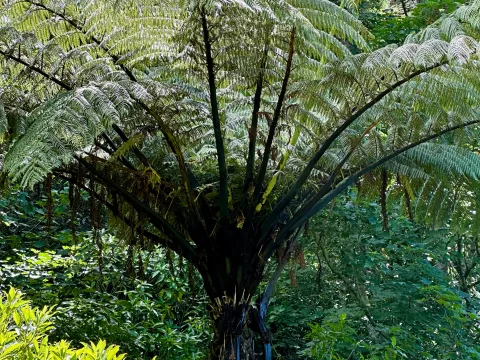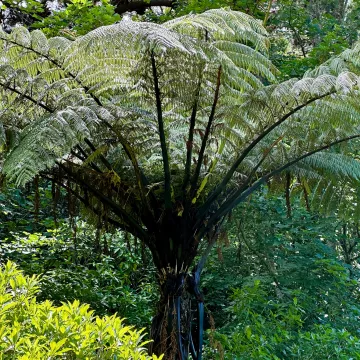
Black tree fern
Sphaeropteris medullaris
Description
Sphaeropteris medullaris, commonly known as the black tree fern, belongs to the family Cyatheaceae. It is a magnificent species often regarded as one of the most iconic tree ferns in the world due to its immense stature and the dramatic appearance of its black-scaled trunk, which can grow to impressive heights in favorable environments.
Native to New Zealand and various Pacific islands, this fern thrives in moist, sheltered forest habitats. Its historical significance includes its use by Māori people, who valued the starch-rich pith of the trunk as a source of food. Today, it remains a botanical icon, representing the lush, prehistoric beauty of its native ecosystems.
The botanical structure is defined by a stout, upright trunk reaching up to 6–10 meters in height, topped with a crown of dark green, feathery fronds that can extend up to 5 meters. These fronds are spirally arranged and create a canopy effect. The trunk itself is uniquely marked by the scars of shed fronds, which give it a distinct, dark, patterned appearance.
Cultivation requires specific climatic conditions, ideally mimicking temperate rainforests. The plant thrives in high humidity and moderate, stable temperatures, generally struggling in frost or extreme heat. Soil should be rich in organic matter, slightly acidic, and well-draining, as the fern is highly susceptible to root decay if the substrate becomes waterlogged.
- Requires partial shade to avoid frond scorch.
- Consistent irrigation is vital, including trunk misting.
- Regular monitoring for scale insects and spider mites is necessary.
- Protection from strong, drying winds is essential for structural integrity.
The primary use of Sphaeropteris medullaris is ornamental. It is a prized specimen for conservatories and botanical gardens in subtropical regions. When managed correctly, it acts as a central focal point in landscape design. Disease management focuses primarily on preventing fungal infections caused by poor drainage or excessive stagnant humidity around the crown.
Photo gallery