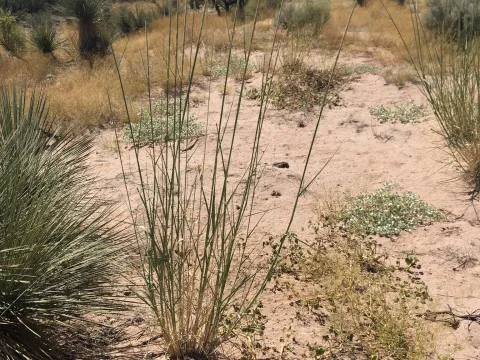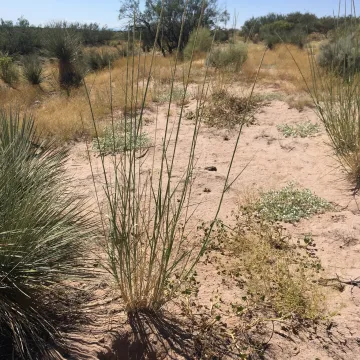
Giant dropseed
Sporobolus giganteus
Description
Giant dropseed (Sporobolus giganteus) is a perennial grass species within the Poaceae family. Recognized for its impressive resilience, this plant has evolved to thrive in some of the most arid environments, specifically utilizing deep root systems to access subsurface water, which allows it to remain green even during prolonged dry spells.
The native distribution of this grass is largely centered in the southwestern United States and northern Mexico. It is a dominant species in sandy desert grasslands and is particularly well-adapted to environments where soil moisture is volatile. Over time, its cultivation potential for similar arid climates has been recognized internationally for land rehabilitation.
Botanically, Sporobolus giganteus is characterized by robust, erect culms that can grow to significant heights. Its leaves are coarse, narrow, and resistant to mechanical damage. The inflorescence is a distinct panicle that produces small, grain-like seeds. The root architecture is particularly notable, spreading extensively to stabilize loose sandy soils against wind erosion.
Agronomic requirements are centered on the necessity for well-drained, sandy soils. The plant thrives in full sun and requires very little irrigation once established. Planting is typically done in early spring or late summer when temperatures are moderate. While fertilizer is rarely necessary in its native habitat, initial establishment may benefit from minor nutrient inputs in highly depleted soils.
The primary agricultural uses for Giant dropseed are soil stabilization and livestock grazing. In arid-land management, it is prized for its ability to prevent dune movement and stabilize fragile desert soils. As a forage grass, it provides a stable source of biomass for cattle and wild grazers, especially during seasonal gaps when more palatable forage is unavailable.
- Exceptional tolerance to high heat and drought.
- Superior ability to stabilize sandy, erodible soils.
- Low-maintenance requirements for cultivation.
- High biomass production in arid ecological zones.
Regarding pest and disease management, the species is relatively hardy. While rust fungi may appear during uncharacteristically wet seasons, these infections are usually minor. Pests such as grasshoppers can occasionally impact foliage volume, but the plant's robust nature allows it to recover quickly under normal seasonal conditions without the need for intensive pesticide intervention.
Photo gallery