Common chickweed
Stellaria media (L.) Vill.
Description
Common chickweed (Stellaria media (L.) Vill.) is a herbaceous annual plant belonging to the Caryophyllaceae family. It is recognized globally for its remarkable adaptability and role in various ecosystems, often found in cultivated fields and gardens.
Originating from Europe and temperate Asia, this plant has become naturalized in many parts of the world. Its success is attributed to its ability to germinate throughout the growing season, provided there is enough moisture to support its rapid development.
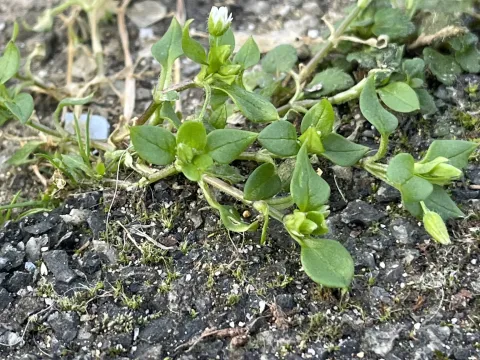
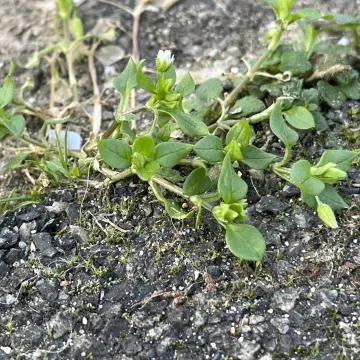
Botanically, the plant features prostrate or ascending stems that reach lengths of up to 40 centimeters. The leaves are ovate and arranged in opposite pairs. The small, star-shaped white flowers are a distinctive hallmark of the species, appearing in terminal cymes during the flowering period.
Regarding cultivation and soil requirements, chickweed thrives in cool, moist, and nutrient-rich soils. It prefers partial shade but can adapt to full sun if the soil moisture levels are consistently high. Management in agriculture requires active soil cultivation, as the plant can rapidly cover the surface, competing for water and nutrients.
Economically, chickweed is utilized as a nutritious fodder for poultry and livestock due to its high mineral and vitamin content. In some regions, it is used as a culinary herb or in traditional medicine for its soothing properties. Despite being considered a weed, its role in soil moisture retention makes it useful in specific permaculture contexts.
- Highly efficient seed dispersal mechanisms.
- Excellent survival rates in cool climates.
- Rich in Vitamin C, iron, and calcium.
- Significant biomass production in short periods.
Photo gallery