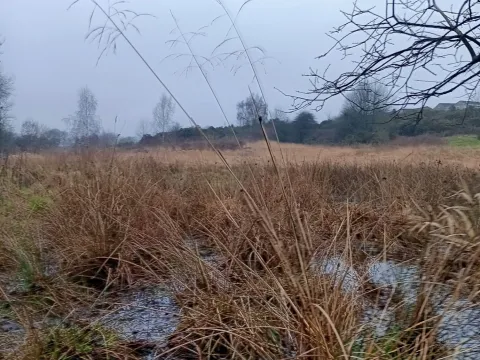

Tufted hairgrass
Deschampsia cespitosa (L.) P. Beauv.
Description
Tufted hairgrass (Deschampsia cespitosa) is a prominent perennial grass belonging to the Poaceae family. It is widely recognized for its dense, mounded growth habit, producing high-quality forage and providing excellent ground cover in cooler temperate regions across the Northern Hemisphere.
This species is native to a broad range of habitats, spanning from moist meadows to alpine regions. In agricultural settings, it is valued for its remarkable tolerance to acidic and waterlogged soils. Its ability to thrive in challenging environmental conditions makes it a key species for land reclamation projects and soil stabilization efforts.
Botanically, the plant features narrow, stiff, dark green leaves that grow from a dense base. The flowering stems, or culms, rise to heights between 50 and 120 cm, ending in delicate, branched panicles that can exhibit shades of gold, purple, or silver. This structure provides not only biomass but also significant aesthetic value.
Agricultural management of tufted hairgrass focuses on moisture management, as the plant performs best in sites with consistent soil moisture. It is relatively drought-sensitive in extreme heat but highly cold-hardy. Maintenance involves appropriate fertilization regimes and controlled grazing or mowing cycles to prevent the vegetation from becoming too coarse and unpalatable.
- Requires moist, acidic to neutral soil types.
- Excellent for erosion control on slopes and stream banks.
- High tolerance for winter frost and low temperatures.
- Can be used for forage in early spring.
Pests and diseases, such as leaf rust and grass-feeding insects, may occasionally affect dense stands. Integrated pest management, including balanced nitrogen application and the removal of stagnant biomass, is generally sufficient to maintain healthy and productive stands of the grass over many years.
Photo gallery